Showing posts with label Harry Ruby. Show all posts

Sunday, March 16, 2014

Copacabana

Copacabana
May 30, 1947
United Artists
Comedy, Musical
VHS
B-

This is Groucho's most entertaining movie in a dozen years, although he's not the funniest person in it.  No, it's not Carmen Miranda, although she has her moments.  No, the one who made me laugh the hardest was "Andy Russell, the voice of romance."  Like many people in the movie, he's playing a version of himself, but he's so damn goofy that I don't see how he could ever have been taken seriously as a crooner.  Both Groucho and Carmen have dual roles, she as "Carmen" and the nonexistent "Mademoiselle Fifi."  (When he says there's no woman in the world like Fifi, I thought of Capt. Tuttle on M*A*S*H.)  Groucho mostly plays Lionel Q. Deveraux (the Q stands for his father's love of pool), but he also shows up in the old greasepaint and frock coat, as a rising young talent, to sing "Go West, Young Man," a Kalmar & Ruby ditty that I assume was written for Go West and left out for some reason.  The Medved brothers picked Groucho & Carmen as one of the worst screen couples ever, but I think they're sort of cute together, even if she smooches three or four other guys rather than him, and he spends a lot of time hitting on other women, all of whom sass him.  One of them, the cigarette girl, was played by Kay Gorcey, who was then married to Groucho.  (She was Leo Gorcey's ex.)

There's also a subplot that Groucho remarks is about either the boss in love with the secretary or the secretary in love with the boss.  It seems to be the latter, with Gloria Jean as the secretary, six years after she played W. C. Fields's niece "Gloria Jean" in Never Give a Sucker an Even Break.  She, on Andy's advice, tries to serenade her boss, but like George in It's a Wonderful Life when Mary tries to sing to him, he thinks she's not feeling well.  It turns out that he's crazy about "a little chick who likes Andy."  All the confusion, including the "murder of Fifi," is untangled in the end, and the Hollywood agent thinks it would make a great picture, so we end with a mini-film within a film.  Well, maybe not a great picture, but give it a chance.

William H. O'Brien was in A Night at the Opera.  Bert Stevens was in Citizen Kane.  Dick Elliott, who plays the hotel manager, was the man on the porch in It's a Wonderful Life, the one who says, "Youth is wasted on the wrong people."  Cy Schindell was a bouncer in Wonderful Life as well as this movie.  Kenner G. Kemp and Dee Turnell would go on to Singin' in the Rain, Mari Blanchard to Abbott and Costello Go to Mars.  Columnist Earl Wilson would also play himself in two of my '60s movies, Beach Blanket Bingo and Where Were You When the Lights Went Out?
Friday, March 14, 2014

A Night in Casablanca

A Night in Casablanca
October 12, 1946
United Artists
Comedy, Musical
VHS
C

The Marx Brothers "retired" after The Big Store, and who could blame them?  This was their post-war comeback movie, but it's not any better than Store.  Then again, it's not any worse.  They're Dumont-less this time, although they do have Sig Ruman again, much more villainous than he was in A Night at the Opera and A Day at the Races.  (As in Store, the serious plot involves a string of murders.)  The movie isn't really a parody on Casablanca, although the Nazis are causing trouble here, too.  The Marxes, especially Harpo (playing "Rusty," as he did in Go West), look old and tired.  (They were then in their mid to late 50s.)  The jokes are mostly old and tired, too, although there are moments I smiled a little, as when Harpo indeed is "holding up a wall."  This wasn't quite the end for the comedy team, but I haven't seen Love Happy in about thirty years, so I can't tell you if it's any worse.  I have Groucho coming up in 1947's Copacabana and 1968's Skidoo.

Mary Dees was in The Women.  Philip Van Zandt was in Citizen Kane.  And Dan Seymour was in Casablanca.  Kalmar & Ruby's "Who's Sorry Now" (from 1923) is sung by the villainess, a whole night club, and then Groucho.

Wednesday, February 12, 2014

A Night at the Opera

A Night at the Opera
November 15, 1935
MGM
Comedy, Musical
VHS
B-

Today's tale:  So the Marx Brothers went to MGM, and "genius" Irving Thalberg said, "Women don't like your movies.  You need more sappy romance, boring songs, and, oh yeah, temporary defeat."  They listened to him and had a hit movie again.  The End.

OK, there's a bit more to it than that, but that's basically the story on how this film came to be, and how, after Thalberg's death, the formula was beat into the ground until we got, well, The Big Store (1941).  At least here they had good writers, not just Marx veterans Kaufman and Riskind, Kalmar and Ruby, but newcomers Robert Pirosh, George Seaton, and Al Boasberg, who would return for A Day at the Races.  I'm not tagging the newbies, because I reached the label limit for this post.  But, yes, Buster Keaton, then down on his luck, also contributed.  The writing, especially Groucho's wisecracks, is amusing some of the time, without the highs or lows of Monkey Business (its nearest equal so far).  Despite the Code, Groucho still gets some suggestive lines, not just the censored-by-individual-states reply to "Otis, do you have everything?" ("I haven't had any complaints yet"), but one about Mrs. Claypool (good ol' Dumont) not yet having  experienced his "services."  There is too much of Kitty Carlisle and Allan Jones as the romantic couple, but, hey, they're much better than the pair in The Cocoanuts.  (Or the one in Roberta for that matter.)  And, yes, the songs, not just the opera, are boring, but I like Chico at the piano (an instrumental of the "All I Do Is Dream of You" song Debbie Reynolds sings in Singing in the Rain) and Harpo at the, yeah, harp (sounding a bit proto-Pet Sounds, believe it or not).

Alex Chivra and Frances Maran were in Flying Down to Rio.  Stanley Blystone, the television operator in Phantom Empire, is a ship's officer here.  A couple of the Fields folk appear, George Irving and Jerry Mandy.  Mario Dominici and Leo Sulky were in Duck Soup.  Edmund Mortimer was in both FDtR and Soup.  Allan Jones, Sig Ruman, and extras Edna Bennett, Ruth Cherrington, Field Norton, and Phillips Smalley would be back in A Day at the Races, while villain Walter King would return in Go West.  Lorraine Bridges would be in Wizard of Oz, Bruce Sidney in Citizen Kane, and Al Bridge in Miracle in Morgan's Creek.  Art Howard and Edward Keane went on to It's a Wonderful Life.  Kitty Carlisle would appear as a singer more than fifty years later in Radio Days.


Wednesday, February 5, 2014

Duck Soup

Duck Soup
Nov. 17, 1933
Paramount
Comedy, Musical
DVD
B+

I recently saw this in a crowd of all ages and they laughed uproariously, the kids included.  I've seen it so many times, I think more than Horse Feathers, that I can't rate it higher, but it is still a near-great musical comedy.  Once again, Kalmar & Ruby did the music, and they also wrote the screenplay.  (Sheekman and Perrin did additional dialogue.)  The musical numbers-- "His Excellency Is Due," "The Freedonian National Anthem," "These Are the Laws of My Administration," and of course the war medley-- are fantastic, and the dialogue is generally sharp.  Some of the corniest jokes ("Dollars, Taxes") and some of the cleverest ("I'll hold your seat till you get there.  After you get there, you're on your own") have been quoted for decades, probably not always by people who know the source.  (The line about shorter hours, starting with the lunch hour, has popped up a whole bunch of places.)

The weakest parts are probably those with Edgar Kennedy as the lemonade seller, although I do like the hat mix-up and the way that Chico tells Kennedy that he and Harpo are spies.  It's partly my bias against silent-movie-style humor, but on the other hand, I still delight in the Groucho & Harpo mirror scene.  It seems like they have more to do with each other than usual in this movie, especially with Harpo (who as in Horse Feathers plays a character named Pinky, I think because of his "red" hair) as Groucho's chauffeur, although the tattoo sequence is good, too.

That scene shows how censorship was enforced, but not strictly.  Harpo's doghouse would've been an outhouse, but they couldn't get away with that.  On the other hand, when Groucho wants to see a tattoo of his grandfather, it's pretty clear that Harpo is going to take down his trousers.  Also, later Harpo seems to be about to go to bed with a woman (and the "Wu-Hu!" sound effect from International House seems particularly appropriate to any Sims player), but instead beds down with, of course, a horse.

Oh, and there is a duck in this movie, a duck-shaped music box that Harpo sets off.  Duck Soup means "an easy task," which I guess running the country is for Groucho, and spying is for Harpo and Chico.  Everyone else in the movie, including Zeppo, seems to find their patience tried.  ("You must come over some time and try my patience.")

This is the movie where Groucho references the song "That's Why Darkies Were Born," whose title out of context sounds more racist than it is.  (The Paul Robeson version makes the irony of the lyrics clear.)  I suppose objections could be raised to "All God's Chillun Got Guns" in the war medley, but I take it as cheerful parody of both spirituals and the hypocritical reasons offered for wars fought for "faith."

I do have a problem with the scene where Harpo breaks into the apartment where the woman's about to take a bath.  Usually, when he's chasing women, it seems less menacing than this.  That said, the pay-off, with the woman's husband (the lemonade seller) finding Harpo in his bath is good.

In contrast, this is probably my favorite movie for the Groucho/Dumont relationship.  Yes, he still insults her, but he's actually kind of sweet to her at different points.  I wish that there had been a Marx Brothers movie with both Dumont and Todd, but Raquel Torres does a nice job as Vera Marcal.

Poor Zeppo is back to playing Groucho's secretary.  (Insert the dictator/dictation joke.)  He was happy to retire from acting after this movie, but his elder brothers were far from through.  Except at Paramount.  This movie did poorly at the box office, the Depression audiences looking for something more optimistic in this first year of FDR.  So it was over to MGM, where they'd listen to "genius" Irving Thalberg.  But that tale must wait till 1935....

As easy as duck soup.

Tuesday, February 4, 2014

Horse Feathers

Horse Feathers
August 19, 1932
Paramount
Comedy, Musical
DVD
B+

Why is this so much better than Monkey Business?  After all, it's got the same director, stars, leading lady, and some of the same writers.  (Johnstone, Perelman, and Sheekman, the last appearing uncredited as Typing Sportswriter.)  Yes, it helps that Kalmar & Ruby are doing the music, as they did for Animal Crackers.  We again have a great Groucho-introduction song, this time "Whatever It Is, I'm Against It."  And the song repeated this time, with every Brother giving it at least one rendition, is the marvelous "Everyone Says I Love You."  But the writing is overall stronger, perhaps because the setting of a college is the best yet.

I'm sure this wasn't the first, and it definitely wouldn't be the last, movie to feature college students who look far too old for college.  At least thirty-one-year-old Zeppo has an excuse, since his character has been in one college for twelve years.  Groucho was then forty-one and he's playing Zeppo's father!  Some of the best moments in the movie are Groucho insulting his son, who's "a disgrace to the name of Wagstaff, if such a thing is possible."  At one point, Groucho points to a picture of a horse (guess what part) and is reminded of Zeppo!

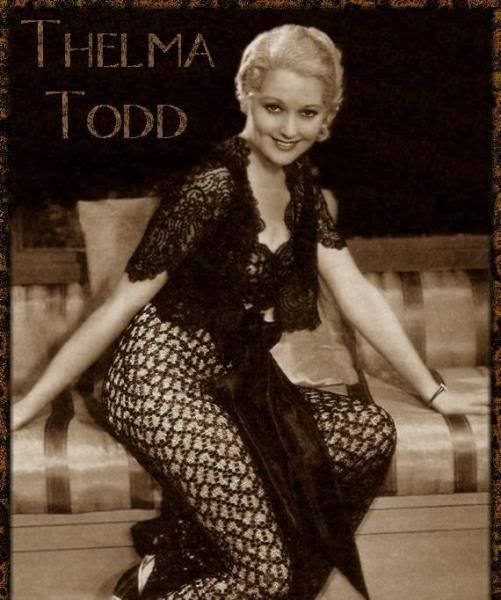
Yes, we're still happily living in pre-Code times, most notably with anything to do with Thelma Todd's character of the "college widow."  All the Brothers and the villain flirt (or more) with her, and the movie actually ends with Groucho, Chico, and Harpo pushing the groom, presumably Zeppo, out of the way so they can all marry her!  She's gorgeous in this movie (in one slinky outfit after another) and seems to be having a better time than in Monkey B, especially during Chico's "music lesson," which Groucho tells us we can go to the lobby to avoid.  The bedroom-farcical scene that this is part of is my favorite, although the opening is a close second.  I love how eventually Harpo just walks along the top of the couch and throws ice out the window, as Groucho and Chico put the moves on Thelma.  This scene is choppy, due to age and later censorship (there's a butchered exchange where Thelma says, "Baravelli, you overcome me," and Chico says, "All right, but remember, it was your idea," which you can still catch with the subtitles on), but it's still hilarious.

Meanwhile, there's a class with Professor Robert Greig, a speakeasy, and a whole lot of nonsense, or horse feathers.  That's what the title means, although Zeppo's portrait is part of it, as is Harpo's abiding love for horses (he had a picture of one as his true love in Animal Crackers), and of course the chariot-riding towards the end.

The whole thing of the importance of football on campus would insure that this movie will probably never become fully dated, bootlegging and college widow notwithstanding.  It is very '30s of course, with a "bum" telling Harpo he wants a cup of coffee.  Guess what Harpo pulls out of his magical coat?  And guess what Groucho throws to Thelma when she's drowning?


Friday, January 31, 2014

Animal Crackers

Animal Crackers
August 28, 1930
Paramount
Comedy, Musical
DVD
B

The trailer says this is ten times funnier than The Cocoanuts.  (Joe Adamson would say five times.)  Of course, the trailer also says that the Marx Brothers were the four funniest men on earth!  Still, there's no question that this is an improvement over the first movie, in every regard.  Yes, it's funnier, including some now famous lines, like "How he got in my pajamas, I'll never know."  Everyone, even Margaret Dumont,  seems more relaxed, and Groucho is starting to really zing people, as well as break the fourth wall (as when he apologizes for one joke).  Harpo and Chico get more musical numbers, sometimes with Groucho wisecracking during.  There are no long, drawn-out numbers by other people.  The "Hooray for Captain Spaulding" song is far better than anything in Cocoanuts, and not surprisingly became Groucho's theme song on You Bet Your Life.

Even the romantic couple are a huge improvement, particularly absolutely charming Lillian Roth.  What other '30s ingenue could get away with lines like "What would you suggest, Mom?  Suicide?" and "We'll be married and divorced in no time"?  Or catch her saying that it might turn out that her boyfriend really is a good artist after all.

What does this movie title mean?  Well, Captain Jeffrey/Geoffrey Spaulding (his name is spelled differently in the opening credits than in the newspaper story) is the famous African explorer and hunter, "bagging tigers" and catching elephants.  While there's often a borderline racism in Marx Brothers movies, I give this one a pass because when he comes in carried by tribal bearers, you just know he hired them somewhere in the city before heading out to Long Island, just so he could make a fabulous entrance, playing off the prejudices of Mrs. Rittenhouse and her guests.  Even the line about the undeveloped pictures of native girls I think of more as an example of getting something past the not-yet-strictly enforced Production Code.  (In Cocoanuts, he offered Mrs. Potter [Dumont] "snappy necking," and here Roth sings about petting!)

There are some weak spots, notably the boxing match and bridge game that Harpo and Chico have with Mrs. Rittenhouse and her frenemy, but overall it's a solid movie.  Speaking of solid, Robert Greig, who plays the plump butler here, will return in Horse Feathers.

For the second movie in a row, Zeppo is playing a character named Jamison.  There are other things that are carried over, not yet (on film anyway) stale routines, among them a lot of Harpo and Chico's physical humor, like their fights, and Harpo giving people his leg.  A joke or two of Groucho's is repeated, like the one about Dumont's character being close to retirement.  But the movie is surprisingly fresh and "modern" (there's a reference to Frigidaire, and Groucho spoofs Eugene O'Neill), while still definitely a 1920s story in early '30s form.  (Again, based on a play.)