Showing posts with label Joan Shawlee. Show all posts

Monday, June 9, 2014

Live a Little, Love a Little

Live a Little, Love a Little
October 23, 1968
MGM
Comedy, Romance, Musical
VHS
B-

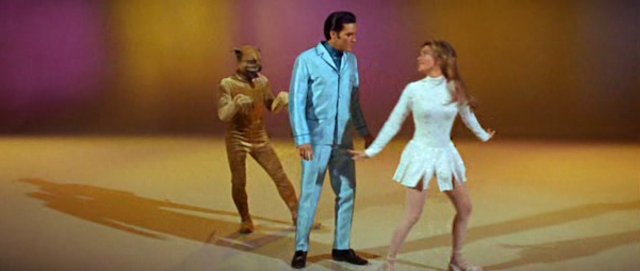
Although directed by Taurog, this is not a typical Elvis movie.  It's based on the book Kiss My Firm But Pliant Lips, which I've read but no longer own.  (And, yes, that would've been a more typical late '60s movie title than LaL, LaL, but it wouldn't sound like an Elvis movie.)  From what I recall, the wackiness of the book is actually toned down for the movie, but you still have Michele Carey, who was Michele in How to Stuff a Wild Bikini, as Bernice/Betty/Susie/Alice Baby, the ex-wife of Dick Sargent, chasing after Elvis-- to the point of making him lose his job and apartment and then renting him a house, and that's just for starters!-- which of course makes Elvis fall in love with her.  (It was the age of the "adorable kooky girl," so I don't think she's meant to be as annoying or felonious as she comes across now.)  Meanwhile, Elvis finds not one but two full-time jobs as a photographer, one at an ad agency, the other at a girlie magazine.  Mrs. Baby has a great dane played by Elvis's dog Brutus, except in the dream sequence where there's a man in a dog costume.  Oh, and Elvis sings "A Little Less Conversation," which became a huge hit about 35 years later, remixed by Junkie XL.

Thirty-five years earlier, International House featured two of the performers in this movie, Sterling Holloway and Rudy Vallee, who in Live a Little play a milkman and one of Elvis's bosses respectively.  And, yes, that's Gidget's most famous dad, Don Porter, as Elvis's other boss, the one at Classic Cat magazine.  Not surprisingly, two of the models, Veronica Ericson and Heidi Winston, were in girlie-magazine-centered The Swinger.  Another model, Brooke Mills, would be Mrs. Gibbons in Freaky Friday.

That's Joan Shawlee, best known as Some Like It Hot's Sweet Sue, as the new tenant in Elvis's apartment.  Larry Billman was a dancer in Beach Ball as well as here.  Thordis Brandt was in Spinout, Hal Riddle in Speedway.  Phyllis Davis, who plays the 2nd secretary, was in Spinout and The Swinger.

This time Elvis's buddy Red West plays a newspaper vendor, while his friend Joe Esposito plays one of the workmen at the newspaper that Elvis gets fired from.  And this time Myrna Ross, formerly one of Von Zipper's Mice, plays a "female companion" (I don't know whose).  Paul Sorensen would do some '70s Disney movies.

The Edge of Reality

Wednesday, April 16, 2014

The Apartment

The Apartment
June 15, 1960
United Artists
Comedy, Drama, Romance
DVD
B+

Although this has big stars, won five Oscars-- best picture, director, original screenplay, film editing, and set direction-- and has received critical acclaim, then and now, it feels like an obscure little picture.  I don't mean that as an insult.  It's just that Wilder's use of black & white here, and the feel of a stageplay (much of the film is indeed set in the title location, and the cast is relatively small), as well as the intimate, human tone, suggest a low-budget gem.  Yet there are those big stars, and the workplace is huge, with the floor that C.C. Baxter (Jack Lemmon) works on seeming to stretch into infinity.  There's another contradiction in the way the genres clash with each other, the comedy, drama, and romance not blending so much as fighting.  This works much better than it did in Wilder's Sabrina, in part because the central romantic triangle is so much better cast.

Lemmon's Baxter has some of the sweetness and "getting-tookness" of Jerry in Some Like It Hot.  But there's also an unsavory undertone, with him loaning his apartment to executives in his company.  Rock Hunter at least had some fun pretending to romance a movie star in order to achieve success, including that key to the executive washroom.  (Here there's also an unseen executive dining room.)  All Baxter gets at first is a cold.  Mostly, he's pushed around by those four executives, including such familiar faces as Mame's Mr. Upson (Willard Waterman), Bewitched's Larry Tate (David White), and My Favorite Martian (Ray Walston).  (The other exec, David Lewis, would go on to John Goldfarb, Please Come Home!)  When Baxter gets to sit at home for a change, he can't even enjoy himself, because (despite a then-cutting-edge channel-changer) there's nothing on TV but westerns and commercials.

This was an early yet transitional movie for Shirley MacLaine, as Fran Kubelik.  She is amazing in it, even though she's giving probably the most understated performance.  Fran makes mistakes, and knows it, but keeps making them, until she finally has her epiphany in the end.  Her chemistry with Lemmon is just right, as is her reply to his declaration of love.

Then there's Fred MacMurray as J.D. Sheldrake.  This was right around the time MacMurray was making Disney movies, and he would soon be the father of "his three sons" on TV.  At first it's strange to see him play such a sleazeball, but it works, because he does have that bland, pleasant surface.  You can believe he's fooled everyone.  It's almost a throwaway, but I like how one of his preteen sons wants to put two flies on a toy rocket and see if they'll "propagate."  Sheldrake shows as much discomfort as he does with other matters that shouldn't be talked about, like adultery and suicide.  It's not that he's prim and proper; it's that he doesn't like to take responsibility.

You can see how much the Code had crumbled in the seven years since The Moon Is Blue.  Then it was a big deal that a virgin went to a bachelor's apartment, took money from an older man with "no strings attached," and came out of the experience with two marriage proposals.  Here, when Sheldrake gives Fran $100 for Christmas, he does it because he's too uncaring to take the time to buy her a present.  She sees it as him calling her a whore, although this isn't said aloud, just through MacLaine's performance.

The movie is also interesting to contrast with its contemporary, Please Don't Eat the Daisies.  There, a blonde bimbo tells a married man (played by Moon Is Blue's David Niven) that she's on the make for him, but he doesn't succumb, even when he's living in a hotel.  Here there's lots of adultery, including almost Baxter's with the wife of a jockey imprisoned by Castro for non-political reasons.  (And one blonde bimbo is compared to Marilyn Monroe, a forgivable cruelty on Wilder's part, considering the hell Marilyn put everybody through on Some Like It Hot.)  The cheating men always make sure to make the train from New York City back to the suburbs, while Niven's character missed trains while keeping vows.

In Daisies, there are some black extras at Macy's, presented as equals to Doris Day.  Here I think there's only a "shoeshine boy," whom Sheldrake gives a small tip.  More memorably, there are three significant Jewish characters: Baxter's landlady and his neighbors the Dreyfusses.  They speak stereotypically, but believably, as Jewish New Yorkers of their time and generation (roughly 50s).  They are also the heart and soul of the movie, the most decent people, even when they're scolding Baxter, whom they think is a love-'em-and-leave-'em playboy, because of what they overhear from his apartment.  Jack Kruschen as Dr. Dreyfuss is quite good at going back and forth between the comedy and drama, and he, along with Lemmon and MacLaine, was nominated by the Academy, although none of them won.  (Kruschen played French in Ma and Pa Kettle on Vacation.)

Comparing this briefly to my other Billy Wilder movies:

  • Fran's suicide attempt is much more realistic and heart-wrenching than Norma Desmond's in Sunset Blvd., because she's a much more sympathetic character, and she's not manipulative, but manipulated. 
  • The business world is presented much less sympathetically than in Sabrina, where we're supposed to believe that Linus Larrabee will somehow be able to balance love and success, despite being a workaholic.  (The bowler hat is a very different symbol in that movie.)
  • Both Some Like It Hot and this movie have sequences that alternate between two "dates," with Lemmon's dates played entirely for laughs, while Junior & Sugar's rendezvous has heat as well as humor, but Sheldrake & Fran's is dramatic with moments of dark wit.

Joe Palma and Joan Shawlee were in Some Like It Hot, she as Sweet Sue.  One of the office workers, Dorothy Abbott, was a showgirl in There's No Business Like Show Business, and would be a radio operator in Palm Springs Weekend.  Hal Smith, who's a drunk Santa here (he's best known as Otis on The Andy Griffith Show), would be Santa and a ranger in Santa and the Three Bears.

Sunday, April 13, 2014

Some Like It Hot

Some Like It Hot
March 29, 1959
United Artists
Comedy, Historical, Musical, Romance
DVD
A

Probably my all-time favorite movie (as well as the top comedy on the AFI list), this is hilarious, clever, sexy, warm, sweet, romantic, cynical, dark, light, wise, silly, gay-friendly, and remarkably well-timed.  That last quality really struck me on this viewing, how not just the wisecracks but everything, from sound effects to exits and entrances, is Swiss-watch-like.  The script by Wilder and Diamond is top-notch, from running jokes like "Type O" to plot twists to its justly famous curtain line to double entendres .  (This time I caught "cherry tarts.")  The three leads were probably never better than they are here: Curtis, playing "heel" Joe, prissy Josephine, and Cary-Grantesque Shell Oil Jr.; Lemmon as insecure Jerry and unsinkable Daphne; and Monroe, still lighting up the screen as she did at the beginning of the decade in All About Eve, here more vulnerable but also more fun-loving as Sugar Kane.  They're well-supported by the rest of the cast, especially the veterans, with "satchel-mouthed" Joe E. Brown priceless as Lemmon's suitor.  Although the film is not a musical per se, it does use music very effectively, not just the jazzy background themes and incidental music, but Marilyn's three very different songs.  (Needless to say, far more memorable than poor Jayne Mansfield's ditties in The Sheriff of Fractured Jaw.)  The costumes, Marilyn's especially, are just right, and the movie is definitely an argument for the beauty of black & white.  (In fact, on their anti-Colorization program, Siskel & Ebert showed a clip of Marilyn teasing and being teased by the shadows and lights during "I Wanna Be Loved by You.")  The comparisons to the farce of the Marx Brothers don't seem overblown, and in fact there's a great improvement on the "crowded compartment" scene of A Night at the Opera.

So why not an A+?  Well, I could say something about perfection, but I think it's that the gangster plot doesn't quite work.  Don't get me wrong.  It provides some great moments, especially when George Raft (Spats) and Pat O'Brien face off, or when we see how stupid and crude Spats's henchmen are, and it doesn't bring the movie too far down, as the gangsters do in The Girl Can't Help It.  But when the mob, or rather mobs, show up in the last half hour of the movie, it takes away some of the sunny bubbliness of the Florida setting.  Still, the two wrong-for-each-other-yet-so-right couples manage to go off into the horizon, on their way to a yacht, and there is that lovely end-line.

Tom Kennedy (not the game show host), who plays a bouncer here, was in the Marxes' Monkey Business.  Jack Gordon was in It's a Wonderful Life.  Carl Sklover was in Abbott and Costello Go to Mars.  Billy Wayne was in The Girl Can't Help It.  Bert Stevens was in Citizen Kane and Auntie Mame, the latter with Arthur Tovey.

Joe Palma and Joan Shawlee (Sweet Sue) would be in The Apartment.  Tiger Joe Marsh would do Beware! The Blob.  Dave Barry (not that Dave Barry), who is Beinstock here, would be in Spinout.  Mike Mazurki, one of Spats's more memorable henchmen, would appear in The Magic of Lassie.  George Raft would play himself in Sextette, while Tony Curtis would chew a lot of scenery as one of the many ex-husbands (the Russian one) of Mae West's character.  Nehemiah Persoff, who's Little Bonaparte, would have a completely different role as Yentl's papa in the Streisand movie.