Showing posts with label Franklin Pangborn. Show all posts

Monday, March 10, 2014

Never Give a Sucker an Even Break

Never Give a Sucker an Even Break
October 10, 1941
Universal
Comedy
DVD
B-

This movie grew on me as it went on.  For the first twenty or twenty-five minutes, I was bored by the not-quite-real-life behind-the-scenes view of Esoteric Studio.  And then Fields shares his script with "Franklin Pangborn" (this time not only married but a film producer).  And things start getting surreal.  Almost every criticism you can think of for the script is voiced by an indignant Pangborn.  Even when we're back in the "real" world, everything is exaggerated, like the frantic drive to a maternity hospital all over a not-yet-overdeveloped Los Angeles, or the soda shop scene that Fields tells us the censor wouldn't let him make into a saloon.  In whichever world Fields is in, he this time has a loyal niece (not daughter), Gloria Jean, sort of as herself.  She was then 15, and would go on to Copacabana (1947).  (She sings in both.)  Margaret Dumont does not play any version of herself, but instead a rich woman who's raising her lovely young daughter on a Russian mountain-top, far away from men, till Fields literally drops into their lives, from the passenger deck of an airplane.  A Russian mountain-top with monkeys.  An airplane with sleeping compartments.  He falls because he's chasing a bottle of booze.  And you thought International House was surreal!

Fields's girlfriend Carlotta Monti again plays a secretary, as she did in The Man on the Flying Trapeze, although not his this time.  Charles McMurphy was in My Little Chickadee.  Bill Wolfe was in both My Little Chickadee and The Bank Dick.  June Preston was in You Can't Cheat an Honest Man.  Kay Deslys was in The Big Store.  Victor Potel would go on to The Miracle of Morgan's Creek.  Brick Sullivan would be in both It's a Wonderful Life and Singin' in the Rain.

Monday, March 3, 2014

The Bank Dick

The Bank Dick
November 29, 1940
Universal
Comedy
DVD
C-

Not only my least favorite W.C. Fields movie, but my least favorite movie in my collection so far.  As before, Fields is a bumbling husband and father who is saved by a deus ex machina at the end.  (Well, more like three or four.)  The movie is very unfocused, with a subplot about Fields as a film director forgotten for about an hour.  All the imagination seems to have gone into the names: the Sousé (accent gravamen over the E) family, Mackley Q. Greene, Og Oggilby, J. Frothingham Waterbury, Miss Plupp, A. Pismo Clam, and Filthy McNasty.  (I didn't say they were funny names.)  I might've gone with a C, but there's gratuitous racism.  (It can't be excused, as that in You Can't Cheat an Honest Man might be.  And, yes, I'm ignoring gratuitous sexism for the most part.)  Even Franklin Pangborn (implausibly cast as a husband and father) can't save his scenes.  And it was odd to see Shemp Howard in a straight-man role-- running the bar with the censor-bait name of "Black Pussy Cafe"-- especially when there are Stooge-like sound effects underlining how unfunny the slapstick is here.  I suggest you skip, and I don't mean in the exercise sense.

Cora Witherspoon, who was in The Women, plays Fields's wife.  Evelyn Del Rio, who portrays his younger daughter, was the crying girl in Honest Man.  Una Merkel plays his elder daughter, and would soon be in The Road to Zanzibar.  This time Grady Sutton is his potential son-in-law, and main victim.  William J. O'Brien was in A Night at the Opera, Vangie Beilby in A Day at the Races.  Russell Hicks and Dick Purcell were in Follow the Fleet.  Fay Adler, Charles Hart, and George Moran were in My Little Chickadee.   Pat West was the warden in His Girl Friday.

Joseph North was a butler in in Thank You, Jeeves! as well, but would play a secretary in Citizen Kane.  Jack Gargan was in The Story of Vernon and Irene Castle, and would also appear in Kane.  William Alston, Eddie Coke, Monty Ford, and Sam Rice are in Kane as well.  Bill Wolfe was in some earlier Fields movies and would go on to Never Give a Sucker an Even Break, as would Jack Roper and Emma Tansey.  This is the last and possibly most forgettable of Jan Duggan's appearances in Fields movies, but she would have a role in The Big Store, which features Al Hill.

We are not amused.

Sunday, March 2, 2014

Turnabout

Turnabout
May 17, 1940
United Artists
Comedy, Fantasy
VHS
C+

Unlike most later body-switch comedies, this one also involves a gender swap, between a bickering married couple, the Willowses (John Hubbard and Carole Landis), with the assistance of their talking genie statue, Mr. Ram.  There's also a lumbering Great Dane, a bear cub, an advertising agency that uses surfboards, and the toughest-to-kill radio since Duck Soup.  Among the confused servants, business partners, and potential clients are Donald Meek, Marjorie Main, Adolphe Menjou (top billing), Mary Astor as his wife, and Franklin Pangborn as Mr. Pingboom.  Director Hal Roach's daughter plays a southern belle secretary with the biggest hat bow since probably 1910.

Unfortunately, in a different way than My Little Chickadee, the movie is never as much fun as it could be.  It is interesting though and, yes, there are moments of queer subtext, as when the wife is in the husband's body (still with her own voice) and befriends Mr. Pingboom.  As with the '50s sitcom plots of the husband and wife swapping chores for a day, the message is that the sexes are and should remain very different, although since the Willowses are upper-middle-class, Sally Willows and her friends are more like the women in The Women than like Lucy and Ethel.  But then, just when you think that order is restored, the movie delivers a surprisingly daring ending.  Pity the rest of the script wasn't that sharp.  It's based on a 1931 book by Thorne Smith (of Topper fame), which became a 1979 sitcom, with Sharon Gless!  She obviously went on to better things, but sadly Carole Landis committed suicide in 1948, due to boyfriend Rex Harrison refusing to divorce his wife.

Jack Rice was in Flying Down to Rio.  Carl M. Leviness was in At the Circus.  Jack Egan and William H. O'Brien would go on to Citizen Kane, George[s] Renavent (Mr. Ram) to Road to Zanzibar, and Kenner G. Kemp to Singin' in the Rain.  Buddy Messinger, who's an elevator boy here, would be one in Andy Hardy Meets Debutante and The Big Store, along with a bunch of movies I don't own.  (Talk about typecasting!)

Friday, February 7, 2014

Flying Down to Rio

Flying Down to Rio
Dec. 29, 1933
RKO
Musical, Comedy
DVD
B-

Released the same day as Design for Living, this is less obviously a pre-Code movie in its situation, but there is a lot of raciness in the dialogue, dancing, and costumes.  As for the dialogue, the line "What have these South Americans got below the equator that we haven't" is a good sample, and most of Ginger Roger's lines are suggestive, as is her song "Music Makes Me." She and Fred dance a less dirty-dancing version of the Carioca than the "Brazilians" do but it's still a very flirty number for them, and, yes, this is the movie that made them stars.  Unfortunately, we have to spend too much time on a love triangle that is "won" by the very unlikable Gene Raymond, when Raul Roulien's character Julio (pronounced by everybody with an American J) is much cuter, nicer, smarter, and nobler.  Oh well, Dolores del Rio is OK.  Pangborn once again works for a hotel, but only in the Miami scenes.

Watch this one not only for Fred & Ginger but for the chorus-girls-strapped-to-airplane-wings finale.  It's not only incredibly campy but the outfits are very scanty.  You're not hallucinating if you think you see nipples!  Also, the film is notable for mocking racism, when black "savages" turn out to be civilized hotel staff.

Design for Living

Design for Living
Dec. 29, 1933
Paramount
Comedy, Romance
DVD
B

"Immorality may be fun, but it isn't fun enough to take the place of one hundred percent virtue and three square meals a day."  So says stodgy Max Plunkett, played by the incomparable Edward Everett Horton.  But the threesome of Miriam Hopkins as Gilda (soft G), Fredric March as Tom, and, yes, Gary Cooper as George would disagree.  Something happens to Gilda that "usually happens to men."  She's fallen in love with more than one man.  She's a "nice" girl but she doesn't want to have to choose between them.  So they make a "gentleman's agreement" to swear off sex.  (This isn't quite the first movie I own to mention the word "sex," since there's a line in an International House song with "sex appeal," but the word and the idea are definitely more central here.)  Unfortunately, Gilda is no gentleman.  She becomes involved with first George and then Tom, and when forced to choose, ends up marrying Max.  She now has her feet on the ground, but she's bored out of her mind.  Until her two exes return for a surprisingly happy ending.

This is very much a pre-Code movie.  In fact, its certificate of approval was withdrawn the next year.  There's nothing crude or smutty about the film, but it has the Lubitsch touch of suggestiveness, mixed with the Ben Hecht sharp wit.  (All they took from Noel Coward was the general situation and one line.)  In the first scene, we're on a French train, and it seems the three passengers are French, until Gilda breaks into a very American "Oh, nuts!" of frustration at trying to communicate.  She's a commercial artist, while George is a fine artist, and Tom a playwright.  She's a very modern woman, and I don't entirely mind when she says that their work is more important than hers, because she's a very opinionated Muse and manager.  She may or may not be a virgin when she meets them, but when Max later "forgives" her for her past, she thinks there's nothing to forgive.  And she's right.

Hopkins has wonderful chemistry with both March and Cooper,who are great together as well.  (In the play, it was clear the men were bisexual, while here they've been best friends and roommates for eleven years.)  It is funny to see "bohemians" in suits and ties, but their tuxes when they're successful make the class differences clearer.  And Hopkins moves from businesswoman frocks to elegant gowns, particularly when she's a bored rich wife.

Edward Everett Horton might have been gay in real life, and he tends to play asexual characters.  Pangborn, in a briefer role than in International House, comes across as more obviously effeminate than Horton, underscored when Gilda tells him he'll like Goodnight, Bassington by Tom, because "it's a woman's play."  William Worthington, who plays a Theatre Patron here, was the Minister of Finance in Duck Soup.

I was tempted to give this movie a B+, but it is a bit slow-moving, which I attribute more to Lubitsch than Hecht, considering how fast-paced His Girl Friday (1940) is.  It's well worth your patience though, with its fine performances, writing, and direction.

Wednesday, February 5, 2014

International House

International House
May 27, 1933
Paramount
Comedy, Musical
DVD
B-

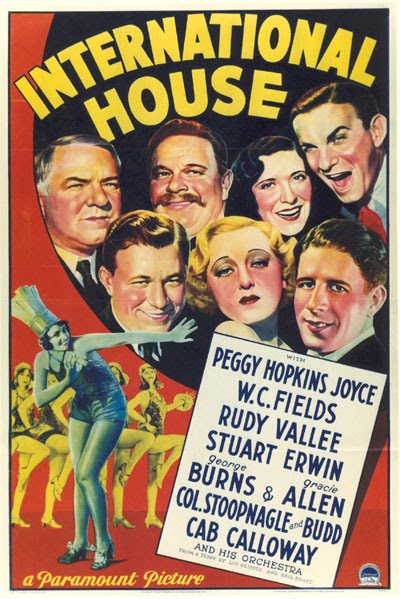
Uneven sort-of-parody of Grand Hotel (1932), this has a large cast gathering in Wu-Hu, China, a town so named only so that it can constantly be punned on in dialogue and sound effects.  (I think Paramount recycled this sound in Duck Soup.)  At one point, the "sissy" hotel manager played by Franklin Pangborn yells "Wu-Hu!" at W. C. Fields, who says, "Don't let the posy [in his boutonniere] fool you."  This is a very Pre-Code movie, with Fields's lines in particular impossible to imagine a year or two later.  "Nuts" was specifically mentioned in the Code, yet Fields repeats it at least a half dozen times, meaning "nuts and bolts," and even if "pussy" wasn't officially banned, he refers to a cat as such with great relish.  Peggy Hopkins Joyce (as her then infamous millionaire-marrying self) sits on the cat but doesn't know what she's sitting on.  When she tells Fields she's sitting on something, he replies, "I lost mine in the Stock Market."

And earlier, Gracie Allen sits on a stethoscope and listens to her "heartbeat."  She and George Burns are probably the best thing about this movie, even if they are doing old vaudeville routines, like the one about her father bringing home the wrong baby carriage.  The movie also has Cab Calloway singing "Reefer Man"!  And a bluesy Baby Rose Marie belting one out.  (She was then 9 and is still alive at 90.  Yes, Dick Van Dyke's Rose Marie.)  And Rudy Vallee singing a love song to his megaphone.  And Sterling Holloway dancing.  And Bela Lugosi, a couple years after Dracula, as Joyce's ex-husband.  Plus many people you've never heard of, although I'm tagging Edmund Breese, who plays Dr. Wong, the inventor of a "television device," because he has a small role in Duck Soup.

While I wouldn't describe the movie as non-racist, it is for its time refreshingly not-very-racist, with the Chinese actually coming off better than the Americans and Europeans.  I think the setting was only chosen to lead to that "Wu-Hu" pun.  And, yes, the movie is of scientific interest, with not only a television that can transmit from anywhere in the world, but also Fields's autogyro.

I'm not a big Fields fan, although I do like how he wreaks more havoc in this hotel in his first five minutes than Harpo and Chico did in an hour of The Cocoanuts.  I ended up buying a very cheap DVD package of ten Fields movies, just so I could own this oddity of a film.  So, although in general I'm going to be blogging about movies I've seen at least a few times, I won't swear to it that I'll have seen all of the other nine Fields films before.  But I do own them, so why not blog?