Showing posts with label RKO. Show all posts

Sunday, March 16, 2014

It's a Wonderful Life

It's a Wonderful Life
January 7, 1947
RKO
Drama, Comedy
VHS
B

This may be the darkest of all "holiday movies," involving as it does suicide, bankruptcy, and unpunished corruption.*  The hero, George, yells at his uncle, wife, and kids, as well as picks fights with strangers.  He wants to escape his little hometown, but he always does "the right thing."  If we smile and/or cry at the ending, it's partly with relief that, despite all George's problems, it's a good thing he was born.  Jimmy Stewart is just right as this complex yet ordinary man, with all his line readings (stuttered or not) natural and believable.  Lionel Barrymore puts enough sarcasm into his dialogue that he never becomes a simple cartoon villain.  The supporting cast, with a lot of familiar faces (some of them mentioned below), is good, especially glowing Donna Reed as George's loyal wife Mary.  (However, I always laugh out loud that we're supposed to be horrified that alternative-universe-Mary has become, gasp, a spinster librarian!)  This time, I was particularly impressed with the children, the younger versions of George, Mary, and Violet matching up with their adult counterparts, and the Bailey kids not only looking like each other, but acting believably for their ages, with no precocity or wisecracks.  (Compare, for instance, Andrew on Family Ties, with his unbelievable dialogue even as a kindergartner.)

As with Citizen Kane and Casablanca, this is a "great" movie that I still find good after many viewings.  I'd rather hang out with the gang in Morgan's Creek, since the visits to Bedford Falls are draining, but it is interesting to see one man's life in a couple hours.  (There are some glitches in chronology, mostly surrounding younger brother Harry's age.  In the alternative world, he dies at 9 in 1919, although born in 1911.  And he seems to be four years younger than George, who's 12 in 1919, but Harry graduates high school in 1928.)

This is yet another credit for Frank O'Connor, this time as a military officer.  Edward Keane and Art Howard were in A Night at the Opera.  Brooks Benedict was in Follow the Fleet.  Lillian Randolph (Annie the maid) was in At the Circus.  Tom Coleman, Mike Lally, and Suzanne Ridgeway were in Citizen Kane.  George Noisom was in The Wizard of Oz and Citizen Kane.  Jimmy the Crow has a larger role here than he did in The Wizard of Oz.  Adriana Caselotti, who sings at Martini's here, was "Juliet's" voice in The Wizard of Oz (as well as Snow White's in the Disney cartoon).  Al Bridge, who was the lawyer Johnson in The Miracle of Morgan's Creek, has a much smaller role here as the sheriff.

Joseph E. Bernard would shortly appear in The Egg and I.  Brick Sullivan would be in Singin' in the Rain, Hershell Graham in The Band Wagon, and Jack Gordon in Some Like It Hot.  Frank Faylen, who plays Ernie was in The Story of Vernon and Irene Castle, and would go on to The Monkey's Uncle.  H.B. Warner, who plays Mr. Gower, was then in his 70s and had credits going back to before World War I; he would play himself in Sunset Boulevard.  Charles Lane, who describes himself as a "bright young man," was then 41 and still had decades ahead of him as an actor.


*Well, unpunished except on Saturday Night Live:  http://www.ebaumsworld.com/video/watch/81249131/

Monday, March 10, 2014

Playmates

Playmates
December 26, 1941
RKO
Comedy, Musical
VHS
B

I won't argue that this is a good movie, but I do find it a very entertaining one, especially the music.  Kay Kyser and his band sort of play themselves, as does John Barrymore in his last film.  Throw in Patsy Kelly as one of the fast-talking agents (the other is Peter Lind Hayes, who I only I know of because he apparently was on the first TV sitcom to feature a baby), mix in Lupe Velez (best known for the Mexican Spitfire series),and give M.A. Bogue, AKA Ish Kabibble, lots to do, so even the non-musical scenes are fun.  (Check out, to take just one example, Patsy as Lulu saying that the A Vitamins "taste like 'ell to me," a great sneak past the censor.)

But, oh, that music!  The "best" (well, funniest) numbers are first and last.  "Thank Your Lucky Stars and Stripes" (in this movie released shortly after Pearl Harbor) has to be one of the most ridiculous "patriotic" songs ever.  Lines like, "If you can sing and believe in anything," "If you have shoes and can say the things you choose," and "If you can joke and enjoy an artichoke," along with stuff about traffic cops and sweater girls and ham & eggs, belted out in enthusiastic big-band style, convince me.  "Romeo Smith and Juliet Jones" with its happy ending and slang like "hepcat" and "thirty grand" is of course a big hit with the posh Long Island audience onscreen.  Even the lesser songs, like "Humpty Dumpty Heart" and "Que Chica," couldn't possibly be taken seriously, at least not nowadays.

Surprisingly, in the midst of the in(s)anity, Barrymore, who's been chewing whatever of the scenery he can wrestle away from everyone else, gives a fine, understated rendition of Hamlet's soliloquy.  It doesn't blot out the later image of Kyser having a dream where he fights a bull with Barrymore's face (only to wake up kissing Hayes, thinking it's Velez), but it is a touching moment.  The movie's title by the way (which decades later would suggest Playboy bunnies) is a pun on "play" in the theatrical sense.

Marshall Ruth was in Turnabout.  Fred Trowbridge was in Citizen Kane.  Jack Gargan was in The Bank Dick and Citizen Kane.  Barry Norton would go on to Casablanca, Bill Cartledge to The Miracle of Morgan's Creek (as the short soldier).  Leon Belasco, who plays Prince Maharoohu, would appear in Road to Morocco (and a 1972 TV-movie called Playmates).


Sunday, March 9, 2014

Citizen Kane

Citizen Kane
September 5, 1941
RKO
Historical, Drama, Comedy
DVD
B

While I don't believe this is The Best Movie Ever, or even close, I won't deny that it's a good movie, and in its lighter moments a fun movie.  The movie darkens (literally and figuratively) as it goes on, but the opening newsreel is a delightful little parody in itself.  The story is told over and over, in many forms, from many perspectives, some of them not necessarily the ones we're supposed to be in.  (How would Susan know what audience members were doing during her opera debut?  And then there's the problem of whether anyone actually overheard Kane's famous last words.)  The film looks and to some degree sounds like nothing before it.  (The overlapping dialogue in some scenes may owe something to His Girl Friday, which gave a different but not entirely unlike view of the newspaper business.)  Although we sense Welles's stage roots in some scenes, there are shots that have incredible depth, and sometimes height.  The acting is generally solid.  I didn't find the old-age make-up always believable, and I think the movie is about half an hour too long, but overall I was drawn in and entertained.

Cyril Ring, who has a very small role here, was the villain Yates in The Cocoanuts.  Field Norton was in A Night at the Opera, Ray Flynn in A Day at the Races, Cliff Herd in Room Service, Buck Mack in At the Circus, and Lew Harvey in Go West.  Thomas Pogue was in Andy Hardy Meets Debutante, Arthur Yeoman in You Can't Cheat an Honest Man, Joan Blair in The Women, and Jack Egan in Turnabout.  William Alston, Eddie Coke, Monty Ford, Jack Gargan, and Sam Rice were in The Bank Dick.  Frank O'Connor, who's in so many of my earlier movies, appears in the Madison Garden scene.  Buddy Messinger branches out from his usual elevator boy roles to play "Man at Boat Dock," one of many.

George Noisom was in The Wizard of Oz and would go on to It's a Wonderful Life, which also features Tom Coleman, Charles Meakin, and Larry Wheat.  Frank McClure was in His Girl Friday and would appear in Auntie Mame.  Carl Deloro and Hercules Mendez would go on to Casablanca, Suzanne Ridgeway to Road to Morocco, Robert Dudley to Miracle of Morgan's Creek, and Shimen Ruskin to Love and Death.  And, yes, that's Agnes "Endora" Moorehead as Kane's mother, although the only other movie I know I have her in is Charlotte's Web.

Tuesday, February 25, 2014

The Story of Vernon and Irene Castle

The Story of Vernon and Irene Castle
March 29, 1939
RKO
Historical, Musical, Drama
DVD
C

Slow, corny, somewhat depressing movie that somehow ends up being proto-propaganda for U.S. involvement in World War II.  It's set 1911 to 1918 and patriotic Brit Vernon joins up when World War I breaks out.  (Astaire shows no trace of a British accent, although Vernon was nineteen when he emigrated to New York.  No New York accent either, for that matter.)  Before that, it's mostly a tale of the real-life celebrity dancers' rise and success.  Around the midpoint, when Edna May Oliver (Aunt March in Little Women) shows up, the movie sort of springs to life, and the montage sequence seems to have a better, livelier director.  Mostly though, Fred and more particularly Ginger are hamstrung by playing real roles, and ones they're not suited for.  (I really missed the sassy, brassy Ginger of Flying Down to Rio, as she played insecure, innocent Irene.)  I was getting so antsy that I started speculating on Walter Brennan as "Walter" having a threesome with the Castles.  (He does seem very taken with Vernon.)  Some of the dancing's pretty good of course, but you're not missing much if you skip this one.

William Worthington was in Duck Soup, Jean Stevens in Room Service, and Esther Muir was "Flo" in A Day at the Races, which also featured Max Lucke.  Leonid Kinskey, who plays the "bohemian" painter, was in Duck Soup as the agitator and would be in Casablanca as Sascha.  Kay Sutton appeared in Roberta, Brooks Benedict in Follow the Fleet.  Tiny Jones, who'd just done You Can't Cheat an Honest Man, shows how she got her nickname, here appearing as the small woman who goes through a revolving door.  Leyland Hodgson was also in Honest Man.  Donald "Jumping Butterballs" MacBride has a more leering, less angry role than in Room Service.  Douglas Walton was in Thank You, Jeeves!, and incidentally was Percy Bysshe Shelley in The Bride of Frankenstein.

Edmund Mortimer, George Irving, and Frank O'Connor were in previous movies of mine, and Mortimer would soon appear in At the Circus.  Rolfe Sedan would shortly be in The Wizard of Oz.  Jack Gargan would go on to The Bank Dick, Adrienne D'Ambricourt to Casablanca.  Eugene Borden plays a Frenchman in All About Eve as well as here.  Frank Faylen, who's an uncredited Adjutant here, would be much more memorable as not only Ernie in It's a Wonderful Life, but as Dobie Gillis's TV father.

Monday, February 24, 2014

Room Service

Room Service
September 30, 1938
RKO
Comedy
VHS
C

It's not a good sign that William Seiter also directed Roberta, although of course the main problem here is that Morrie Ryskind had to tailor a successful non-Marx play to the Marxes.  Unlike the whimsically titled Paramount movies, this is even more literally titled than the MGM movies, with at least two title-drops in the mostly hotel-set story.  You can make an entertaining movie set in a hotel, but there have got to be more interesting events than here.  (Same Time Next Year succeeds partly by not just saying the word "sex," as Groucho does here, and by covering a much longer span of time.)  Yes, there's a flying turkey and fake suicides and one of the fastest courtships ever (five days, although admittedly Ann Miller is pretty cute).  And, yes, it's nice to see Lucy, no longer blonde, with a more substantial role.  But she and the Marxes seem restrained most of the time.  (Chico hardly seems Italian, or awake.)

I kept thinking the movie might make it to sort of funny, as with the topical references to Gypsy Rose Lee and FDR.  As it is, the frequent exclamation of "JUMPING BUTTERBALLS!!" is unintentionally more amusing than any of the intended gags.  This may well be the Marx movie I own that I've seen the least, and when I got a phone call about half an hour before the ending, I forgot that I hadn't finished watching, until I went through the living room again.  Furthermore, while the music in their MGM movies hasn't been anything amazing so far, it beats two renditions of "Swing Low, Sweet Chariot."  This film's only for the Marx completist.

Donald MacBride (the "butterballs" shouter) and Bruce Mitchell would go on to The Story of Vernon and Irene Castle, Phoebe Campbell and Cliff Herd to Citizen Kane.  Charles Halton, who's "Dr. Glass" here, would appear twenty years later, in his 80s, as the school principal of High School Confidential!, with a pivotal role as the bank examiner of It's a Wonderful Life along the way.

Funnier than the actual movie.

Friday, February 14, 2014

Follow the Fleet

Follow the Fleet
February 20, 1936
RKO
Musical, Romance, Comedy
DVD
B+

Although Fred & Ginger are again sharing the bill and the screen with another couple, and the other man is played by Randolph Scott, this is far superior to 1935's Roberta.  It helps that the other woman, as Ginger's mouse-turned-knockout sister is Harriet Hilliard, AKA Ozzie Nelson's wife, and she sings in a likable, realistic way, unlike Irene Dunne.  True, she doesn't look all that much different after Lucille Ball gives her a makeover, but this isn't the most realistic movie.  (Lavish stage sets on a boat?  Which never rocks?)  Yes, Lucy has more to do here than in Roberta, and as "the tall blonde angel" puts a sailor in his place with a memorable putdown.  As for Scott, he's playing a bit of a heel here (as he admits), but he's not beyond redemption.  He has a fling with a rich divorcee, who's not presented as a bad girl, although a bit of a dumb blonde.  Also surprising, Ginger and Fred slip some naughtiness past the Code, as when Ginger, who sings in a dime-a-dance club, says she convoyed a fleet of sailors on the dance floor, "on my feet."  Fred even leads an all-male-couples dance lesson!

Mostly though, he's dancing on his own or with Ginger, and she gets a solo turn as well.  In their dance contest number in particular, they're remarkably fluid, helped by the bellbottoms they both wear, although it's back to gown and tux for the final production number, which is about renouncing suicide!  And there's a monkey in a sailor suit.  Maybe Flying Down to Rio isn't their most surreal film.  In any case, this has their best chemistry so far, and I loved how they banter about who's going to propose to whom.  They also work well with their best friends in the movie, she with Hilliard of course, and he with Scott.  While this is much less of a drama than Roberta, the emotions feel more genuine.  Plus the Irving Berlin et al. score is great, although there are probably too many reprises of "We Joined the Navy."  Overall, this film is a delight!

Mary Stewart and Eddie Tamblyn were in Flying Down to Rio.  Jane Hamilton, Maxine Jennings, and Kay Sutton were in Roberta.  James Pierce was in Horse Feathers as one of the "attempted kidnap victims" of Harpo and Chico.  Harry Beresford was the doctor in Little Women.  Allen Wood later appeared in Fred & Ginger's The Story of Vernon and Irene Castle.  Billy Dooley would go on to A Day at the Races,  Lita Chevret to The Women, Frank Jenks to His Girl Friday, Tony Martin to The Big Store, and Russell Hicks and Dick Purcell to The Bank Dick.  I can't tag everyone, and most of these are minor roles, here and elsewhere, although Martin gets far too much screen time in Store.

Tuesday, February 11, 2014

Roberta

Roberta
March 8, 1935
RKO
Romance, Musical
DVD
C+

As with the W. C. Fields films, I got a package of four Fred & Ginger movies, in this case just for Flying Down to Rio.  This film is disappointing, considering one, it's based on a book by Alice Duer Miller (whose Come out of the Kitchen is a fun read:  http://rereadingeverybookiown.blogspot.com/2012/03/come-out-of-kitchen.html); two, it has some good songs, including the Oscar-nominated "Lovely to Look at"; and three, Fred & Ginger aren't as peripheral as they are in FDtR.  Unfortunately, they're still playing the supporting couple, and this time the main pair are both charm-free: Randolph Scott, coming across as a killjoy Joel McCrea, and Irene Dunne, who ruins "Lovely" and "Smoke Gets in Your Eyes" by singing in that horrific mid-'30s to early-'40s pseudo-operatic style that too many female singers used in the movies.  Watch this one with your hand on the remote, fast-forwarding till you get to any scene with Fred in it, and even then be prepared for too much Scott and Dunne.  (Ginger has much less to do than Fred.)

OK, and you can keep an eye out for various cameos.   Not only is one of the fashion models Lucille Ball, but William "Fred Mertz" Frawley plays a bartender!  And another fashion model, Wanda Perry, would have a small role in Ball's Mame.  Model Donna Mae Roberts would appear in 1943's The Gang's All Here.  Of the Wabash Indianians, Hal Borne was in Flying Down to Rio, while "tricky-voiced" Candy Candido would do a memorable voiceover as an apple tree in Wizard of Oz.  Rita Gould would appear in The Women.  No one plays Roberta; it's just the name of the design studio Scott's aunt owns.  The fashions range from forgettable to regrettable to acceptable.


Friday, February 7, 2014

Flying Down to Rio

Flying Down to Rio
Dec. 29, 1933
RKO
Musical, Comedy
DVD
B-

Released the same day as Design for Living, this is less obviously a pre-Code movie in its situation, but there is a lot of raciness in the dialogue, dancing, and costumes.  As for the dialogue, the line "What have these South Americans got below the equator that we haven't" is a good sample, and most of Ginger Roger's lines are suggestive, as is her song "Music Makes Me." She and Fred dance a less dirty-dancing version of the Carioca than the "Brazilians" do but it's still a very flirty number for them, and, yes, this is the movie that made them stars.  Unfortunately, we have to spend too much time on a love triangle that is "won" by the very unlikable Gene Raymond, when Raul Roulien's character Julio (pronounced by everybody with an American J) is much cuter, nicer, smarter, and nobler.  Oh well, Dolores del Rio is OK.  Pangborn once again works for a hotel, but only in the Miami scenes.

Watch this one not only for Fred & Ginger but for the chorus-girls-strapped-to-airplane-wings finale.  It's not only incredibly campy but the outfits are very scanty.  You're not hallucinating if you think you see nipples!  Also, the film is notable for mocking racism, when black "savages" turn out to be civilized hotel staff.

Wednesday, February 5, 2014

Little Women (1933)


Little Women
Nov. 24, 1933
RKO
Drama, Comedy, Historical
VHS
B-

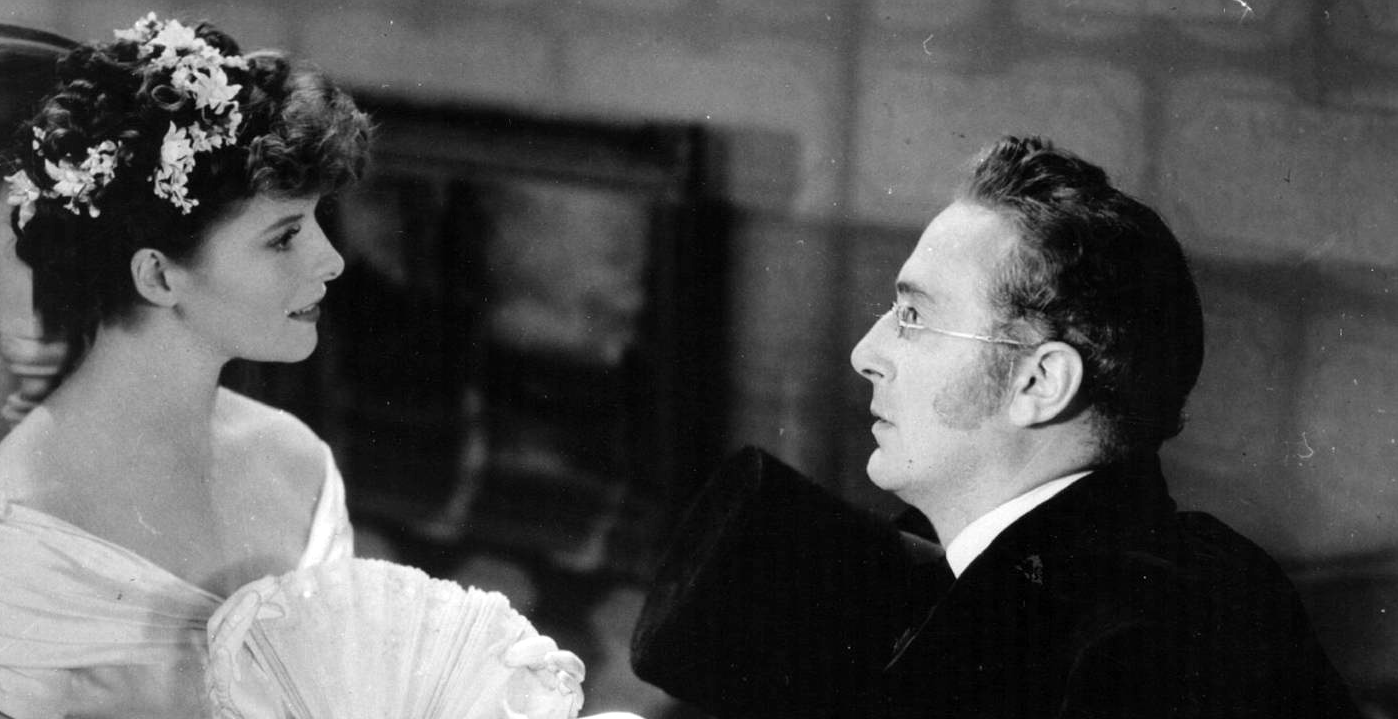
While this is a reasonably faithful adaptation of the classic children's novel (http://rereadingeverybookiown.blogspot.com/2012/02/little-women.html), I have to say that having watched it twice in the last couple months, it feels incomplete.  The problem is that it's too much of a Katharine Hepburn vehicle.  Yes, she's well cast as Jo and does a great job, and yes, the book is more about Jo than the other three sisters.  Nonetheless, I think there should've been more about the other sisters, especially Amy.  Ironically, when we don't see more sides of her, Beth, and Meg, it actually shortchanges Jo's characterization, because we don't get as much of a sense of what her sisters mean to her.  I was surprised though on this viewing how good Paul Lukas is as Prof. Bhaer, giving what's the most natural performance in the film.

You may wonder why I didn't tag any of the performers besides Nydia Westman, who has a small comic role as a maid.  Well, she's actually the only one I know for a fact I have in another of my movies.  I like Hepburn, but not enough to collect her films.

I'll probably say more about this version of the story when I get up to the Winona Ryder version in 1994.