Showing posts with label Douglas Dumbrille. Show all posts

Thursday, March 6, 2014

The Big Store

The Big Store
June 20, 1941
MGM
Comedy, Musical
VHS
C

While this is much livelier than Room Service, I'm going to have to put it on the same level, because, unlike At the Circus and Go West, which offer "Lydia the Tattooed Lady" and the big train scene respectively, there's not really anything that the Marxes do here that stands out.  In fact, the only amusing moments I recall are deadpan Virginia O'Brien, as Kitty, inventing rock & roll (OK, technically still swing, but she is singing about rocking, a baby), and Charles Lane showing up at the end and being very Charles-Laney as the Finance Company Man.  (He always played the same stern type, including in It's a Wonderful Life.)  Yes, it's nice to see Groucho romancing Dumont again and insulting the villain.  (Douglas Dumbrille, who was the horse-scaring-voiced Morgan in A Day at the Races, is the even more sinister Mr. Grover here.)  But there's just too much boring music, which sadly includes Harpo in a "mirror scene" that is nothing like the one in Duck Soup.  Also, there's a perfect example of what I call gratuitous racism, where for no reason at all, four black cotton-pickers show up in the middle of the "Sing While You Sell" production.  (OK, other than O'Brien's weird lullaby, I did like Groucho's remark about Technicolor being too expensive for the fashion show, which I suspect is a dig at The Women.)  Don't get me started on the various ethnic families shopping for beds!

Jan Duggan, who did a few Fields movies, plays the wife Groucho insults in the bed department.  Perennial elevator operator Buddy Messinger actually has a few lines this time.  Russell Hicks was in Follow the Fleet.  Al Hill and Pierre Watkin were in The Bank Dick.  Lennie Bluett sang in A Day at the Races as well as this movie.  And, yes, that's Auntie Em, Clara Blandick, as the nice old lady that the male romantic lead makes a record for.

Lew Harvey and Milton Kibbee would go on to Citizen Kane, Kay Deslys to Never Give a Sucker an Even Break.  Victor Potel, who plays the father of the Swedish kids, would be a newspaper editor in The Miracle of Morgan's Creek.

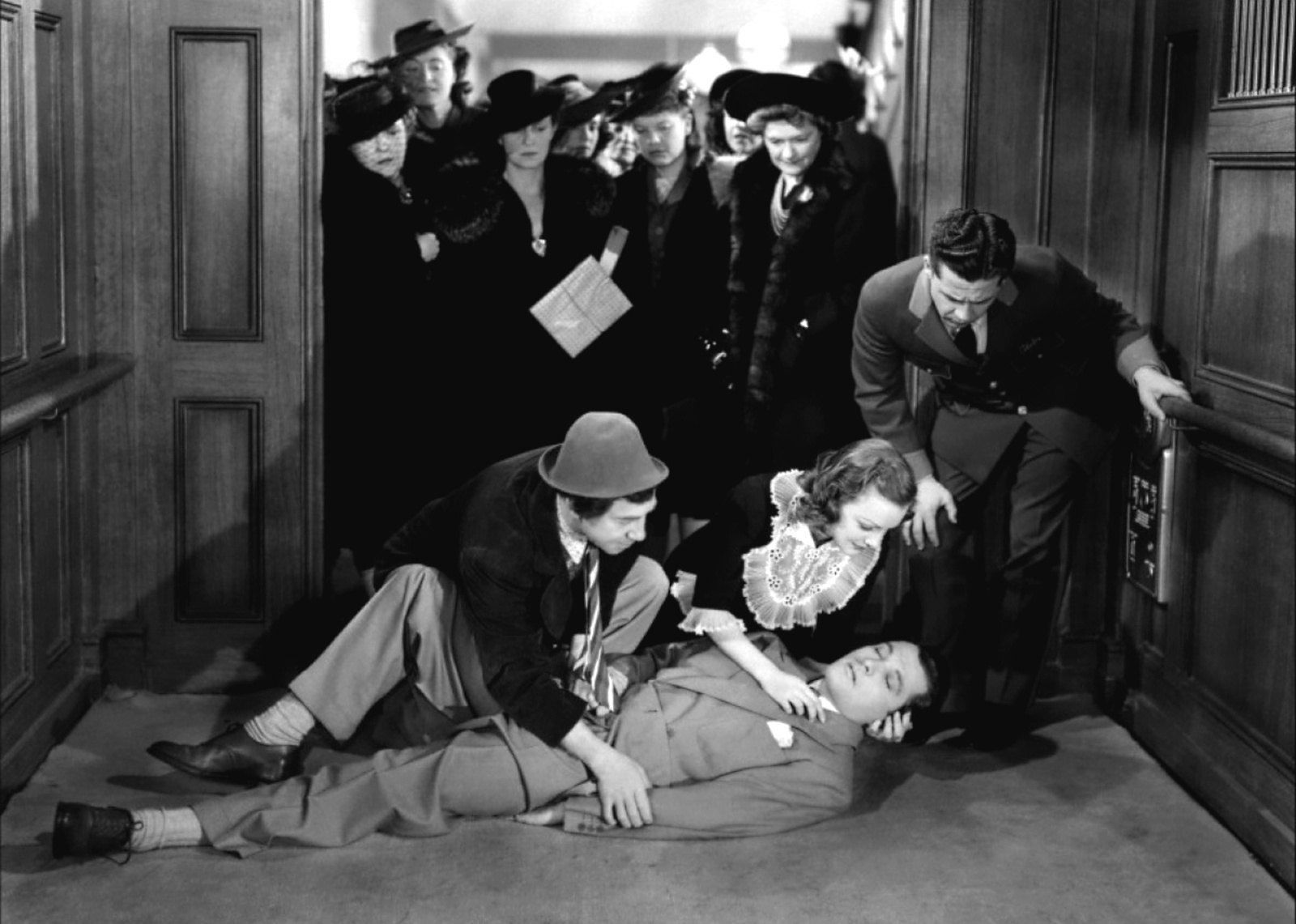

(The last picture is stolen from this very funny piece:  http://www.sandiegoreader.com/weblogs/big-screen/2012/jul/31/dig-a-hole-tony-martin-and-his-emtenement-symphony/)

Sunday, February 23, 2014

A Day at the Races

A Day at the Races
June 11, 1937
MGM
Comedy, Musical
VHS
C+

Once again, as in A Night at the Opera, Sam Wood directs, Allan Jones is the male romantic lead, Sig Ruman and his beard are mocked by Groucho, and Kaufman, Pirosh, Seaton, and Boasberg worked on the script.  This time, Maureen O'Sullivan is the female romantic lead, and she's more appealing than anyone since Lillian Roth.  Also, the movie doesn't suffer the over-inflated reputation of its immediate predecessor.  So in a way, I have a softer spot for it than I do for Night, but I will admit that it's just not as good a movie.

It starts out all right, and for awhile I was thinking of giving it a B-, like Night.  The brothers all have their moments, Chico especially in the "tootsie-frootsing" of Groucho and in his Jew-does-Italian-does-Irish house detective disguise, Harpo during his medical exam (I like how he "shouts" aah), and of course Groucho, especially when he's dancing.  Margaret Dumont actually shows a range of emotion (from A to C) for a change, although she's not given enough to do with Groucho.  Yes, the Water Carnival sequence is far too long (the entire movie is about double the length of Thank You, Jeeves!), but Chico and Harpo again have some nice musical moments.

Then around the 80- or 90-minute mark (I wasn't watching the clock, and my VCR doesn't have the time points), things start to sour.  We get another down-on-their-luck sequence, this time with the Brothers and the romantic couple picking up their spirits by hanging out in Shantytown, where the local Negroes salute a flute-playing Harpo as Gabriel, as in the angel.  (It might make sense if he were playing a horn.)  It is the best musical sequence but is marred by disjointedness (it can't decide if it's a medley or a jam session) and of course racism.  While the singers and dancers are undeniably talented-- one of them, Etta Moten, also sang in Flying Down to Rio-- their exaggerated facial expressions, especially eye-rolling, will probably have you rolling your own eyes, in disbelief or disgust.  And then the whole undercutting of the big horse race near the end goes on far too long, paling in comparison to the football sequence in Horse Feathers, which was itself far from their best filmic climax.  The very ending of this film, with the characters singing bits of songs (including one of Groucho's that was foolishly edited out) and Groucho actually sounding sincere as he proposes to Dumont, isn't bad but it's too little too late.  Results, the Brothers' worst movie since The Cocoanuts, although still watchable in bits and pieces.

Frankie Darro, "Frankie" from Phantom Empire, appears as the rival jockey.  Marx and/or Fields regulars Edith Kingdon, Edward LeSaint, Edmund Mortimer, Frank O'Connor, and Cyril Ring have small roles.  Esther Muir, who appears as "Flo," would have a small part in The Story of Vernon and Irene Castle, as would musician Jack George and doctor Max Lucke.  Billy Dooley would go on to The Double Wedding, Lee Murray to The Wizard of Oz, Jack Kenny to You Can't Cheat an Honest Man, Vangie Beilby to The Bank Dick, Ray Flynn and Field Norton to Citizen Kane, Robert Middlemass and Buck Woods to The Road to Zanzibar, Victor Potel to Miracle of Morgan's Creek, Helen Dickson and Arthur Stuart Hull to It's a Wonderful Life, Florence Wix to High Society, and Harry Wilson to Some Like It Hot.  Furthermore, Kenny Baker, who would be Jones's counterpart in At the Circus, pops up here as a party guest, as does Carl M. Leviness, who has a much smaller role than Baker's in Circus.