Showing posts with label Jack Kruschen. Show all posts

Tuesday, May 6, 2014

Dear Brigitte

Dear Brigitte
January 8, 1965
Fox
Comedy
VHS
C+

Although this has the same director, screenwriter, and studio as Take Her, She's Mine, I think it's a weaker film.  I don't know how much of this can be blamed on the book it's based on, Erasmus with Freckles (1963), but the movie feels as if it was both immediately dated and too early.  Billy Mumy (now 10 but still passing for 8) plays Erasmus, who's a mathematical genius with a huge crush on Brigitte Bardot.  She shows up late in the film (not at all worried about stalkers, although they were a real life problem for her), and is as lovely as ever, but I always got the impression she was more of a '50s star, and of rather racy movies at that, and it seems odd that a boy as young as Erasmus would have a crush on her, as opposed to, say, Sandra Dee.

Speaking of Gidget, Cindy Carol again follows in Dee's footsteps, this time as Jimmy Stewart's teenage daughter.  Carol is just as whiny, and as poor an actress, as she was in Gidget Goes to Rome, and there's an odd moment when she calls her father a "square" because he's not obsessed with money like she is.  Part of the weirdness of this movie is that Stewart is playing a proto-hippie-- a poetry professor who lives on a houseboat, hates math and science, and is worried about the nuclear generator on campus, as well as about what "this campus will be like in five years"-- and it's not only strange casting, but it seems like it would have worked better in a '70s or '80s movie.

Oh, and there's also a gambling subplot, with the usually upright John Williams as the unscrupulous Peregrine Upjohn.  Glynis Johns, as Stewart's wife, is given a bit more depth than she got in Mary Poppins, while Ed Wynn again supplies whimsy, this time talking to the camera, "like in that movie Tom Jones."  (In case you were wondering why Frankie Avalon keeps doing it in the Beach Party movies.)  Fabian plays Cindy Carol's boyfriend, but, no, he doesn't sing.  (The idea of him crooning "Dear Brigitte" as a title song, a la all those James Darren "Gidget" songs, is not without appeal.)

The always versatilely accented Jack Kruschen plays the Austrian (I think) psychiatrist Dr. Volker.  Louise Lane, who plays the saleslady, was "Jazzy Dame" in Auntie Mame.  Harry Carter, who was "Man Departing Plane" in Take Her is a reporter here; James Brolin again plays a college student; Pitt Herbert, who was a police sergeant there, is the bank manager here; Gene O'Donnell, Frank there, is Police Lt. Rink here; and Charles Robinson, who was Stanley, is now George.  As in Pajama Party, Jesse White plays a crook, this time bookie Cliff Argyle.

Paula Lane and Jane Wald would shortly be in John Goldfarb, Please Come Home!  Lyn Edgington would soon do Girl Happy.  Richard Lane, who's the racetrack announcer here, would be the roller rink announcer in The Shaggy D.A.  (As far as I know, none of these Lanes are related.)

"Technology is a great threat!  Oo, nifty instant photo!"

Wednesday, April 16, 2014

The Apartment

The Apartment
June 15, 1960
United Artists
Comedy, Drama, Romance
DVD
B+

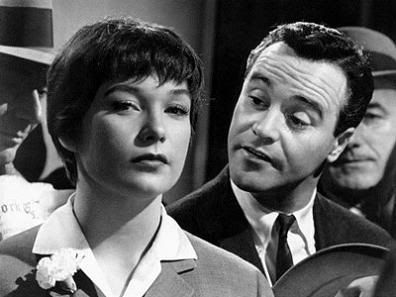
Although this has big stars, won five Oscars-- best picture, director, original screenplay, film editing, and set direction-- and has received critical acclaim, then and now, it feels like an obscure little picture.  I don't mean that as an insult.  It's just that Wilder's use of black & white here, and the feel of a stageplay (much of the film is indeed set in the title location, and the cast is relatively small), as well as the intimate, human tone, suggest a low-budget gem.  Yet there are those big stars, and the workplace is huge, with the floor that C.C. Baxter (Jack Lemmon) works on seeming to stretch into infinity.  There's another contradiction in the way the genres clash with each other, the comedy, drama, and romance not blending so much as fighting.  This works much better than it did in Wilder's Sabrina, in part because the central romantic triangle is so much better cast.

Lemmon's Baxter has some of the sweetness and "getting-tookness" of Jerry in Some Like It Hot.  But there's also an unsavory undertone, with him loaning his apartment to executives in his company.  Rock Hunter at least had some fun pretending to romance a movie star in order to achieve success, including that key to the executive washroom.  (Here there's also an unseen executive dining room.)  All Baxter gets at first is a cold.  Mostly, he's pushed around by those four executives, including such familiar faces as Mame's Mr. Upson (Willard Waterman), Bewitched's Larry Tate (David White), and My Favorite Martian (Ray Walston).  (The other exec, David Lewis, would go on to John Goldfarb, Please Come Home!)  When Baxter gets to sit at home for a change, he can't even enjoy himself, because (despite a then-cutting-edge channel-changer) there's nothing on TV but westerns and commercials.

This was an early yet transitional movie for Shirley MacLaine, as Fran Kubelik.  She is amazing in it, even though she's giving probably the most understated performance.  Fran makes mistakes, and knows it, but keeps making them, until she finally has her epiphany in the end.  Her chemistry with Lemmon is just right, as is her reply to his declaration of love.

Then there's Fred MacMurray as J.D. Sheldrake.  This was right around the time MacMurray was making Disney movies, and he would soon be the father of "his three sons" on TV.  At first it's strange to see him play such a sleazeball, but it works, because he does have that bland, pleasant surface.  You can believe he's fooled everyone.  It's almost a throwaway, but I like how one of his preteen sons wants to put two flies on a toy rocket and see if they'll "propagate."  Sheldrake shows as much discomfort as he does with other matters that shouldn't be talked about, like adultery and suicide.  It's not that he's prim and proper; it's that he doesn't like to take responsibility.

You can see how much the Code had crumbled in the seven years since The Moon Is Blue.  Then it was a big deal that a virgin went to a bachelor's apartment, took money from an older man with "no strings attached," and came out of the experience with two marriage proposals.  Here, when Sheldrake gives Fran $100 for Christmas, he does it because he's too uncaring to take the time to buy her a present.  She sees it as him calling her a whore, although this isn't said aloud, just through MacLaine's performance.

The movie is also interesting to contrast with its contemporary, Please Don't Eat the Daisies.  There, a blonde bimbo tells a married man (played by Moon Is Blue's David Niven) that she's on the make for him, but he doesn't succumb, even when he's living in a hotel.  Here there's lots of adultery, including almost Baxter's with the wife of a jockey imprisoned by Castro for non-political reasons.  (And one blonde bimbo is compared to Marilyn Monroe, a forgivable cruelty on Wilder's part, considering the hell Marilyn put everybody through on Some Like It Hot.)  The cheating men always make sure to make the train from New York City back to the suburbs, while Niven's character missed trains while keeping vows.

In Daisies, there are some black extras at Macy's, presented as equals to Doris Day.  Here I think there's only a "shoeshine boy," whom Sheldrake gives a small tip.  More memorably, there are three significant Jewish characters: Baxter's landlady and his neighbors the Dreyfusses.  They speak stereotypically, but believably, as Jewish New Yorkers of their time and generation (roughly 50s).  They are also the heart and soul of the movie, the most decent people, even when they're scolding Baxter, whom they think is a love-'em-and-leave-'em playboy, because of what they overhear from his apartment.  Jack Kruschen as Dr. Dreyfuss is quite good at going back and forth between the comedy and drama, and he, along with Lemmon and MacLaine, was nominated by the Academy, although none of them won.  (Kruschen played French in Ma and Pa Kettle on Vacation.)

Comparing this briefly to my other Billy Wilder movies:

  • Fran's suicide attempt is much more realistic and heart-wrenching than Norma Desmond's in Sunset Blvd., because she's a much more sympathetic character, and she's not manipulative, but manipulated. 
  • The business world is presented much less sympathetically than in Sabrina, where we're supposed to believe that Linus Larrabee will somehow be able to balance love and success, despite being a workaholic.  (The bowler hat is a very different symbol in that movie.)
  • Both Some Like It Hot and this movie have sequences that alternate between two "dates," with Lemmon's dates played entirely for laughs, while Junior & Sugar's rendezvous has heat as well as humor, but Sheldrake & Fran's is dramatic with moments of dark wit.

Joe Palma and Joan Shawlee were in Some Like It Hot, she as Sweet Sue.  One of the office workers, Dorothy Abbott, was a showgirl in There's No Business Like Show Business, and would be a radio operator in Palm Springs Weekend.  Hal Smith, who's a drunk Santa here (he's best known as Otis on The Andy Griffith Show), would be Santa and a ranger in Santa and the Three Bears.
Tuesday, March 25, 2014

Ma and Pa Kettle on Vacation

Ma and Pa Kettle on Vacation
April 20, 1953
Universal
Comedy
VHS
C+

The vacation is to Paris, France, with Kim's parents, who appeared in the couple series entries I'm missing.  Sixty-something Pa almost went to France during the first World War, but they "didn't scrape the bottom of the barrel."  He and Ma are of course fish out of water, but not much humor results from this.  (I did like Ma protesting "wife-beating" by interrupting Apache-dancing.)  As if aware that this wasn't enough to work with, the script throws in an espionage plot, with the Kettles facing the Marxes' old nemesis Sig Ruman.  Citizen Kane's nemesis Gettys, on the other hand, played by Ray Collins, is friendly in-law Jonathan here.  The movie never quite clicks, although there are moments, as when an irate Frenchman speaks ill of the Marshall Plan, and when Pa (whose real name is Franklin) thinks the bobbysoxers are chasing him rather than the Sinatra lookalike.  I was most interested in, one, the view of air travel (from Idlewild Airport); and two, the way that Pa luring the French police to the rescue somewhat foreshadows Paul's grandfather's maneuvers in A Hard Day's Night (although it's much funnier there).

We don't get much of the Kettle "childrun," since they're just in the scenes at home.  The eleven returning Kettle kids:

  • Donna Leary, then 16, as Sally
  • Ronnie Rondell, Jr., then 16, as Dannie
  • Elana Schreiner, then 16, as Nancy
  • George Arlen, then 12, as Willie
  • Beverly Mook, then 12, as Eve
  • Sherry Jackson, then 11, as Susie
  • Gary Lee Jackson, age unknown, as Billy
  • Jackie Jackson, age unknown, as Henry
  • Margaret Brown, age unknown, as Ruthie
  • Billy Clark, age unknown, as George
  • Jenny Linder, age unknown, as Sara (and no, I don't know why a family has siblings named Sally and Sara, or Willie and Billy for that matter)

And two newbie Kettle kids:

  • Mark Roberts, 31 (!), takes over from Eugene Persson as Teddy.
  • Jon Gardner (age unknown), who was in Singin' in the Rain, replaces Teddy Infuhr as Benjamin.

Tom doesn't appear, but "Kim and the baby" are visiting him "in camp," presumably a military camp.  Rosie isn't mentioned but probably is away at college.  That gives a total of fifteen kids for Ma and Pa, after the oddity of sixteen in the previous movie.

Oliver Blake and Teddy Hart return as Indians Geoduck and Crowbar.  We learn that they can't read and they're hoping Pa will bring them back spicy French postcards.

Sam Harris was in Citizen Kane.  Suzanne Ridgeway was in Citizen Kane and It's a Wonderful Life.  Franklin Farnum was in Sunset Blvd.  Eugene Borden also played a Frenchman in All About Eve.  Rita Moreno plays a soubrette, the one singing the can-can song.

Stewardess Alice Kelley would show up in a different role for Ma and Pa Kettle at Home.  Gloria Pall, the French Girl Walking Poodle, was actually Brooklyn-born, so it's more appropriate that she would shortly play Tall Girl in New York in Abbott and Costello Go to Mars, which would also feature Russ Conway, Harold Goodwin, and Jack Kruschen.  Manuel Paris would soon be in The Band Wagon.  Alphonse Martell, a restaurant manager here, would be a headwaiter in Gentlemen Prefer Blondes.  Jack Chefe and Jean de Briac would also be in Gentlemen Prefer.