Friday, February 7, 2014

Flying Down to Rio

Flying Down to Rio
Dec. 29, 1933
RKO
Musical, Comedy
DVD
B-

Released the same day as Design for Living, this is less obviously a pre-Code movie in its situation, but there is a lot of raciness in the dialogue, dancing, and costumes.  As for the dialogue, the line "What have these South Americans got below the equator that we haven't" is a good sample, and most of Ginger Roger's lines are suggestive, as is her song "Music Makes Me." She and Fred dance a less dirty-dancing version of the Carioca than the "Brazilians" do but it's still a very flirty number for them, and, yes, this is the movie that made them stars.  Unfortunately, we have to spend too much time on a love triangle that is "won" by the very unlikable Gene Raymond, when Raul Roulien's character Julio (pronounced by everybody with an American J) is much cuter, nicer, smarter, and nobler.  Oh well, Dolores del Rio is OK.  Pangborn once again works for a hotel, but only in the Miami scenes.

Watch this one not only for Fred & Ginger but for the chorus-girls-strapped-to-airplane-wings finale.  It's not only incredibly campy but the outfits are very scanty.  You're not hallucinating if you think you see nipples!  Also, the film is notable for mocking racism, when black "savages" turn out to be civilized hotel staff.

Design for Living

Design for Living
Dec. 29, 1933
Paramount
Comedy, Romance
DVD
B

"Immorality may be fun, but it isn't fun enough to take the place of one hundred percent virtue and three square meals a day."  So says stodgy Max Plunkett, played by the incomparable Edward Everett Horton.  But the threesome of Miriam Hopkins as Gilda (soft G), Fredric March as Tom, and, yes, Gary Cooper as George would disagree.  Something happens to Gilda that "usually happens to men."  She's fallen in love with more than one man.  She's a "nice" girl but she doesn't want to have to choose between them.  So they make a "gentleman's agreement" to swear off sex.  (This isn't quite the first movie I own to mention the word "sex," since there's a line in an International House song with "sex appeal," but the word and the idea are definitely more central here.)  Unfortunately, Gilda is no gentleman.  She becomes involved with first George and then Tom, and when forced to choose, ends up marrying Max.  She now has her feet on the ground, but she's bored out of her mind.  Until her two exes return for a surprisingly happy ending.

This is very much a pre-Code movie.  In fact, its certificate of approval was withdrawn the next year.  There's nothing crude or smutty about the film, but it has the Lubitsch touch of suggestiveness, mixed with the Ben Hecht sharp wit.  (All they took from Noel Coward was the general situation and one line.)  In the first scene, we're on a French train, and it seems the three passengers are French, until Gilda breaks into a very American "Oh, nuts!" of frustration at trying to communicate.  She's a commercial artist, while George is a fine artist, and Tom a playwright.  She's a very modern woman, and I don't entirely mind when she says that their work is more important than hers, because she's a very opinionated Muse and manager.  She may or may not be a virgin when she meets them, but when Max later "forgives" her for her past, she thinks there's nothing to forgive.  And she's right.

Hopkins has wonderful chemistry with both March and Cooper,who are great together as well.  (In the play, it was clear the men were bisexual, while here they've been best friends and roommates for eleven years.)  It is funny to see "bohemians" in suits and ties, but their tuxes when they're successful make the class differences clearer.  And Hopkins moves from businesswoman frocks to elegant gowns, particularly when she's a bored rich wife.

Edward Everett Horton might have been gay in real life, and he tends to play asexual characters.  Pangborn, in a briefer role than in International House, comes across as more obviously effeminate than Horton, underscored when Gilda tells him he'll like Goodnight, Bassington by Tom, because "it's a woman's play."  William Worthington, who plays a Theatre Patron here, was the Minister of Finance in Duck Soup.

I was tempted to give this movie a B+, but it is a bit slow-moving, which I attribute more to Lubitsch than Hecht, considering how fast-paced His Girl Friday (1940) is.  It's well worth your patience though, with its fine performances, writing, and direction.

Wednesday, February 5, 2014

Little Women (1933)


Little Women
Nov. 24, 1933
RKO
Drama, Comedy, Historical
VHS
B-

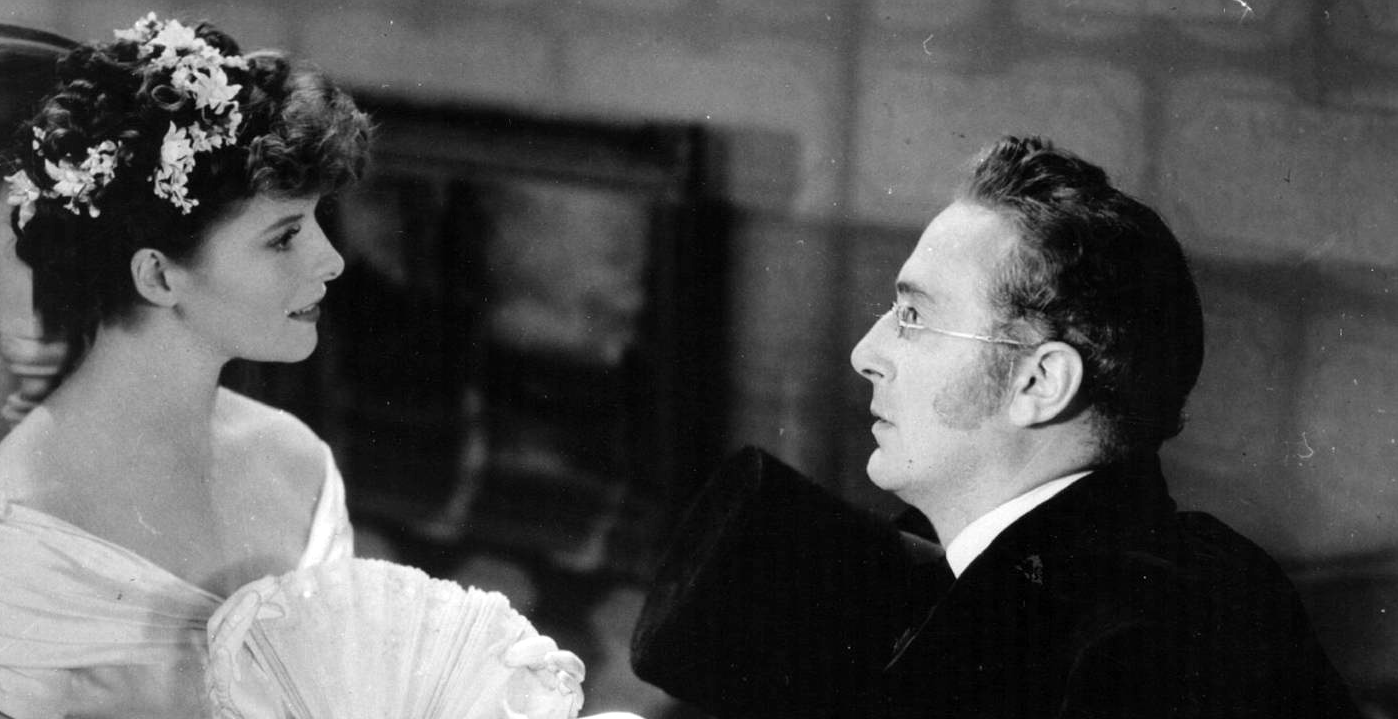
While this is a reasonably faithful adaptation of the classic children's novel (http://rereadingeverybookiown.blogspot.com/2012/02/little-women.html), I have to say that having watched it twice in the last couple months, it feels incomplete.  The problem is that it's too much of a Katharine Hepburn vehicle.  Yes, she's well cast as Jo and does a great job, and yes, the book is more about Jo than the other three sisters.  Nonetheless, I think there should've been more about the other sisters, especially Amy.  Ironically, when we don't see more sides of her, Beth, and Meg, it actually shortchanges Jo's characterization, because we don't get as much of a sense of what her sisters mean to her.  I was surprised though on this viewing how good Paul Lukas is as Prof. Bhaer, giving what's the most natural performance in the film.

You may wonder why I didn't tag any of the performers besides Nydia Westman, who has a small comic role as a maid.  Well, she's actually the only one I know for a fact I have in another of my movies.  I like Hepburn, but not enough to collect her films.

I'll probably say more about this version of the story when I get up to the Winona Ryder version in 1994.

Duck Soup

Duck Soup
Nov. 17, 1933
Paramount
Comedy, Musical
DVD
B+

I recently saw this in a crowd of all ages and they laughed uproariously, the kids included.  I've seen it so many times, I think more than Horse Feathers, that I can't rate it higher, but it is still a near-great musical comedy.  Once again, Kalmar & Ruby did the music, and they also wrote the screenplay.  (Sheekman and Perrin did additional dialogue.)  The musical numbers-- "His Excellency Is Due," "The Freedonian National Anthem," "These Are the Laws of My Administration," and of course the war medley-- are fantastic, and the dialogue is generally sharp.  Some of the corniest jokes ("Dollars, Taxes") and some of the cleverest ("I'll hold your seat till you get there.  After you get there, you're on your own") have been quoted for decades, probably not always by people who know the source.  (The line about shorter hours, starting with the lunch hour, has popped up a whole bunch of places.)

The weakest parts are probably those with Edgar Kennedy as the lemonade seller, although I do like the hat mix-up and the way that Chico tells Kennedy that he and Harpo are spies.  It's partly my bias against silent-movie-style humor, but on the other hand, I still delight in the Groucho & Harpo mirror scene.  It seems like they have more to do with each other than usual in this movie, especially with Harpo (who as in Horse Feathers plays a character named Pinky, I think because of his "red" hair) as Groucho's chauffeur, although the tattoo sequence is good, too.

That scene shows how censorship was enforced, but not strictly.  Harpo's doghouse would've been an outhouse, but they couldn't get away with that.  On the other hand, when Groucho wants to see a tattoo of his grandfather, it's pretty clear that Harpo is going to take down his trousers.  Also, later Harpo seems to be about to go to bed with a woman (and the "Wu-Hu!" sound effect from International House seems particularly appropriate to any Sims player), but instead beds down with, of course, a horse.

Oh, and there is a duck in this movie, a duck-shaped music box that Harpo sets off.  Duck Soup means "an easy task," which I guess running the country is for Groucho, and spying is for Harpo and Chico.  Everyone else in the movie, including Zeppo, seems to find their patience tried.  ("You must come over some time and try my patience.")

This is the movie where Groucho references the song "That's Why Darkies Were Born," whose title out of context sounds more racist than it is.  (The Paul Robeson version makes the irony of the lyrics clear.)  I suppose objections could be raised to "All God's Chillun Got Guns" in the war medley, but I take it as cheerful parody of both spirituals and the hypocritical reasons offered for wars fought for "faith."

I do have a problem with the scene where Harpo breaks into the apartment where the woman's about to take a bath.  Usually, when he's chasing women, it seems less menacing than this.  That said, the pay-off, with the woman's husband (the lemonade seller) finding Harpo in his bath is good.

In contrast, this is probably my favorite movie for the Groucho/Dumont relationship.  Yes, he still insults her, but he's actually kind of sweet to her at different points.  I wish that there had been a Marx Brothers movie with both Dumont and Todd, but Raquel Torres does a nice job as Vera Marcal.

Poor Zeppo is back to playing Groucho's secretary.  (Insert the dictator/dictation joke.)  He was happy to retire from acting after this movie, but his elder brothers were far from through.  Except at Paramount.  This movie did poorly at the box office, the Depression audiences looking for something more optimistic in this first year of FDR.  So it was over to MGM, where they'd listen to "genius" Irving Thalberg.  But that tale must wait till 1935....

As easy as duck soup.

International House

International House
May 27, 1933
Paramount
Comedy, Musical
DVD
B-

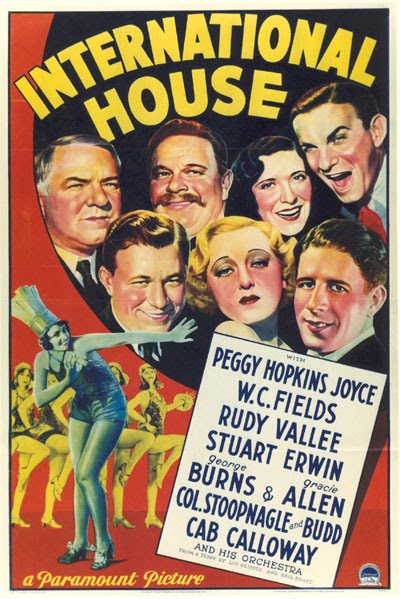
Uneven sort-of-parody of Grand Hotel (1932), this has a large cast gathering in Wu-Hu, China, a town so named only so that it can constantly be punned on in dialogue and sound effects.  (I think Paramount recycled this sound in Duck Soup.)  At one point, the "sissy" hotel manager played by Franklin Pangborn yells "Wu-Hu!" at W. C. Fields, who says, "Don't let the posy [in his boutonniere] fool you."  This is a very Pre-Code movie, with Fields's lines in particular impossible to imagine a year or two later.  "Nuts" was specifically mentioned in the Code, yet Fields repeats it at least a half dozen times, meaning "nuts and bolts," and even if "pussy" wasn't officially banned, he refers to a cat as such with great relish.  Peggy Hopkins Joyce (as her then infamous millionaire-marrying self) sits on the cat but doesn't know what she's sitting on.  When she tells Fields she's sitting on something, he replies, "I lost mine in the Stock Market."

And earlier, Gracie Allen sits on a stethoscope and listens to her "heartbeat."  She and George Burns are probably the best thing about this movie, even if they are doing old vaudeville routines, like the one about her father bringing home the wrong baby carriage.  The movie also has Cab Calloway singing "Reefer Man"!  And a bluesy Baby Rose Marie belting one out.  (She was then 9 and is still alive at 90.  Yes, Dick Van Dyke's Rose Marie.)  And Rudy Vallee singing a love song to his megaphone.  And Sterling Holloway dancing.  And Bela Lugosi, a couple years after Dracula, as Joyce's ex-husband.  Plus many people you've never heard of, although I'm tagging Edmund Breese, who plays Dr. Wong, the inventor of a "television device," because he has a small role in Duck Soup.

While I wouldn't describe the movie as non-racist, it is for its time refreshingly not-very-racist, with the Chinese actually coming off better than the Americans and Europeans.  I think the setting was only chosen to lead to that "Wu-Hu" pun.  And, yes, the movie is of scientific interest, with not only a television that can transmit from anywhere in the world, but also Fields's autogyro.

I'm not a big Fields fan, although I do like how he wreaks more havoc in this hotel in his first five minutes than Harpo and Chico did in an hour of The Cocoanuts.  I ended up buying a very cheap DVD package of ten Fields movies, just so I could own this oddity of a film.  So, although in general I'm going to be blogging about movies I've seen at least a few times, I won't swear to it that I'll have seen all of the other nine Fields films before.  But I do own them, so why not blog?

Tuesday, February 4, 2014

Horse Feathers

Horse Feathers
August 19, 1932
Paramount
Comedy, Musical
DVD
B+

Why is this so much better than Monkey Business?  After all, it's got the same director, stars, leading lady, and some of the same writers.  (Johnstone, Perelman, and Sheekman, the last appearing uncredited as Typing Sportswriter.)  Yes, it helps that Kalmar & Ruby are doing the music, as they did for Animal Crackers.  We again have a great Groucho-introduction song, this time "Whatever It Is, I'm Against It."  And the song repeated this time, with every Brother giving it at least one rendition, is the marvelous "Everyone Says I Love You."  But the writing is overall stronger, perhaps because the setting of a college is the best yet.

I'm sure this wasn't the first, and it definitely wouldn't be the last, movie to feature college students who look far too old for college.  At least thirty-one-year-old Zeppo has an excuse, since his character has been in one college for twelve years.  Groucho was then forty-one and he's playing Zeppo's father!  Some of the best moments in the movie are Groucho insulting his son, who's "a disgrace to the name of Wagstaff, if such a thing is possible."  At one point, Groucho points to a picture of a horse (guess what part) and is reminded of Zeppo!

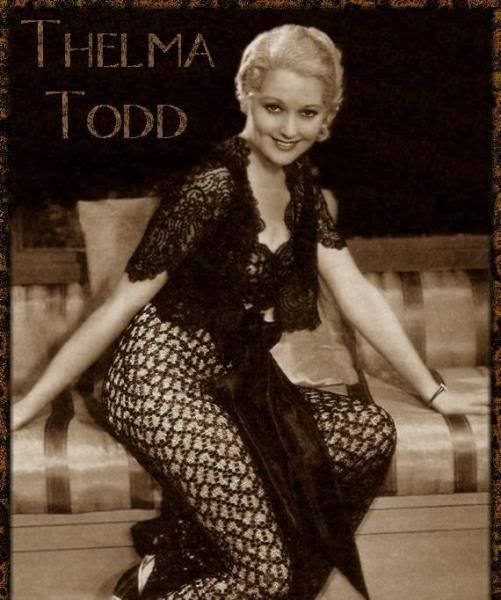
Yes, we're still happily living in pre-Code times, most notably with anything to do with Thelma Todd's character of the "college widow."  All the Brothers and the villain flirt (or more) with her, and the movie actually ends with Groucho, Chico, and Harpo pushing the groom, presumably Zeppo, out of the way so they can all marry her!  She's gorgeous in this movie (in one slinky outfit after another) and seems to be having a better time than in Monkey B, especially during Chico's "music lesson," which Groucho tells us we can go to the lobby to avoid.  The bedroom-farcical scene that this is part of is my favorite, although the opening is a close second.  I love how eventually Harpo just walks along the top of the couch and throws ice out the window, as Groucho and Chico put the moves on Thelma.  This scene is choppy, due to age and later censorship (there's a butchered exchange where Thelma says, "Baravelli, you overcome me," and Chico says, "All right, but remember, it was your idea," which you can still catch with the subtitles on), but it's still hilarious.

Meanwhile, there's a class with Professor Robert Greig, a speakeasy, and a whole lot of nonsense, or horse feathers.  That's what the title means, although Zeppo's portrait is part of it, as is Harpo's abiding love for horses (he had a picture of one as his true love in Animal Crackers), and of course the chariot-riding towards the end.

The whole thing of the importance of football on campus would insure that this movie will probably never become fully dated, bootlegging and college widow notwithstanding.  It is very '30s of course, with a "bum" telling Harpo he wants a cup of coffee.  Guess what Harpo pulls out of his magical coat?  And guess what Groucho throws to Thelma when she's drowning?


Monkey Business (1931)

Monkey Business
September 19, 1931
Paramount
Comedy, Musical
DVD
B-

Well, I could've sworn that my view of the Paramount movies was that they got better and better, but this go-round, my first in a few years, I didn't find this as solid as Animal Crackers.  Yes, there are some great bits-- the puppet show, the Groucho/Thelma scenes, and the Maurice Chevalier imitations-- but the Brothers need more structure to rebel against than a ship and a masquerade party.  Also, there's too much of them picking on innocent victims, not only the man with the "frog in his throat" but most of the women they harass. I've been a Marx Brothers fan longer than I've been a feminist, so I'm not going to get overly p.c. about it, but it's not even funny harassment, except with the opera singer.

The opera jokes, as well as of course the stowing away, foreshadow A Night at the Opera (1935), but there's also a line that hints at A Day at the Races (1937), when someone's looking for a doctor and Groucho asks where the horse is.  He even macabrely predicts Thelma Todd's death in a garage!

Chico meanwhile cracks what may well be his worst set of puns, including but not limited to "strawberry shortcut," "vessel" for "whistle," and "It's better to have loft and lost than never to have loft at all," which Groucho pats him on the back for.  Harpo manages to "sing" along with his brothers in a barbershop quartet and later to, yes, impersonate Chevalier.  Even Zeppo has things to do, making a joke ("What do we plug him with?"), romancing a girl, and fighting a henchman.  Not only that, but Uncle Al Shean contributed to the screenplay, and Frenchie Marx, the seventy-one-year-old father of the Brothers, appears on the dockside.  (He's got a mustache, a white hat, and a proud smile.)  I didn't spot Billy Barty, uncredited except at IMDB, but I'm tagging him anyway.

This is the first of the Marxes' films to not be written for the screen, and it's also the first to feel more '30s than '20s, with Groucho making lots of jokes about money, like "Don't forget that the stockholder of yesteryear is the stowaway of today."  Also, there's the gangster plot, in the same year as Robinson's Little Caesar and Cagney's Public Enemy.  The Code is being ignored more obviously, as the studios tried to lure the Depression audience back into theaters.  All Groucho's jokes about adultery-- Todd's, his, and that of the hapless party guests on the veranda-- would've been frowned upon a few years later.

The title this time is more straightforward, since it means "mischievous behavior."