Showing posts with label Stephen Fry. Show all posts

Tuesday, June 16, 2015

Gosford Park

Gosford Park
January 18, 2002
USA Films etc.
Historical, Mystery, Drama, Comedy
DVD
B+

As with Monsoon Wedding, it takes awhile to sort out all the characters and their relationships in this movie, but fortunately this film holds up even better to repeat viewings.  Yes, it's a mystery, but the whodunnit is just one aspect of the intricate plot.  I also feel that the various threads are resolved satisfactorily, if usually not thoroughly.  The movie was directed and co-written by Robert Altman, so this "ensemble piece" aspect is not surprising.

The setting is a house party in 1932.  We get to know both "upstairs" and "downstairs," and how they sometimes overlap, sexually in particular.  I'm going to mostly just mention the people who are in other films of mine (some of them of course in the Harry Potter series), although they're by no means the only ones giving strong performances.  The closest to a heroine, and the one who solves the mystery, is Mary Maceachran, played by Kelly Macdonald with a soft Scottish burr and very observant eyes.

  • Bob Balaban, who plays Morris Weissman, helped come up with the concept for the film and his character is the most an outsider, as a gay, Jewish Hollywood producer.
  • Stephen Fry this time plays Inspector Thompson, the bumbling detective, who adds a more farcical element to the movie.  (Most of the rest of the humour is very dry.)
  • Michael Gambon, as William McCordle, is very gruff, with none of the warmth or whimsy of his later role as Dumbledore #2.  (Of course, there are Potter fans who see him as just as gruff as Dumbledore.)
  • Richard E. Grant, as George, spends a lot of the time sneering at people, but it works much better than when he was sneering at the Spice Girls as their manager.
  • Tom Hollander, as Anthony Meredith, is the only happily married man in the movie, although he is worried about money throughout most of the story.  His role of the short and insecure man is not unlike his role in In the Loop at the other end of the decade.
  • Jeremy Northam is understated but pivotal as Ivor Novello (the only real character), since he shows the importance of pop culture to "low-class" people, while the upper classes look down on him and it.  He also sings well as Novello.
  • Maggie Smith, as Constance Trentham, not surprisingly comes closer to stealing the film than anyone does, making the most of her wonderful lines.  Yet there's a poignancy to her role, since she, too, worries about money.  (And, yes, there's a certain retroactive irony to McGonagall pleading with Dumbledore.)  She would of course go on to the television series Downton Abbey, which was created by one of the screenwriters here, Julian Fellowes.
  • Geraldine Somerville as Louisa Stockbridge (the red-haired sister) is very different than in her saintly role as Harry Potter's dead mother.
  • Sophie Thompson, as Dorothy, gives one of the messages of the movie, on the importance of loving someone, whether or not the love is returned.
Note:  John Atterbury, who plays Merriman, would be the portrait of Phineas Nigellus Black in Harry Potter and the Order of the Phoenix.

It's so exhausting training new servants.

Sunday, April 26, 2015

Spice World

Spice World
December 15, 1997
Columbia
Musical, Comedy
VHS
C+

This movie has of course dated badly, but let me first offer you some background on where I'm coming from, because my criticisms are probably not the usual ones.  My housemate of the time (still one of my dearest friends) was then a 21-year-old gay man who loved the Spice Girls and he'd play their music a lot.  Since I like pop music, I soon grew to like them.  I was never a great fan, but I could tell them apart.  (Well, to this day I can't remember which is Mel B. and which Mel C., but I knew their Spice identities.)  He, I, and another of his besties went to see this movie.  At almost 30, I was the oldest woman there who wasn't accompanied by a preteen daughter.  We had a blast, with the goofiness and the music.

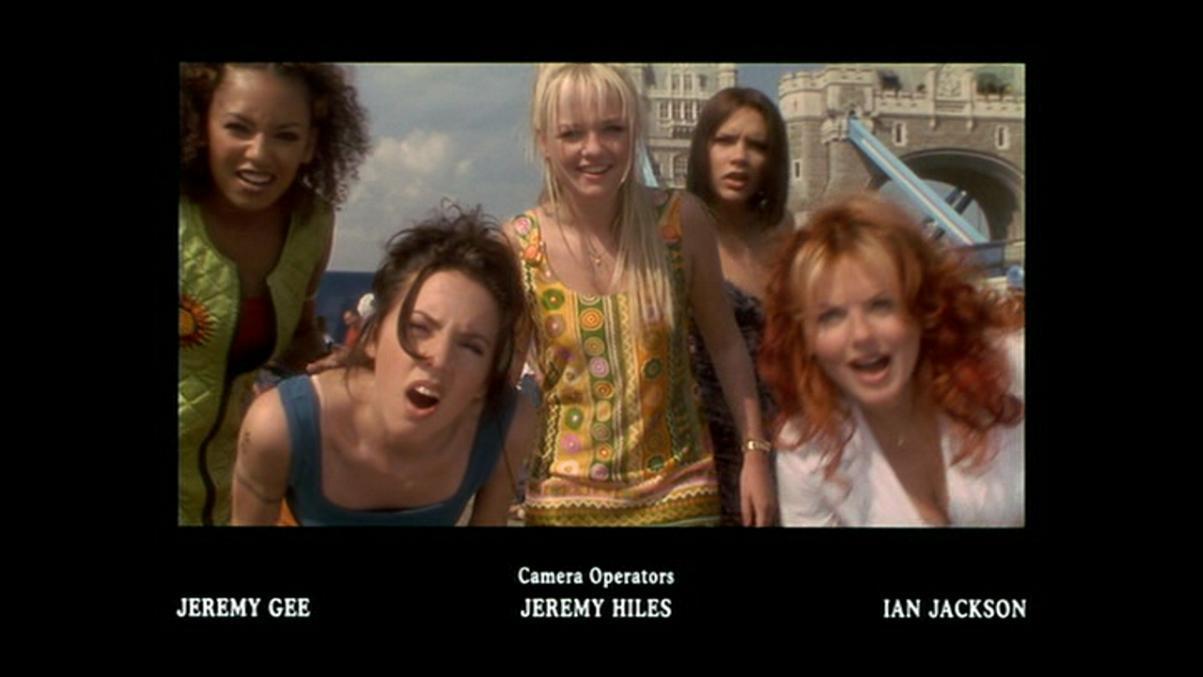
Watching it now, when the Girls breaking up is no longer a plot complication and it's hard to remember their international popularity, what's left is a movie that did not exactly do for the Spices what A Hard Day's Night did for the Beatles one-third of a century earlier.  I want to like this movie more, at least on a camp level, but the problem is that it does not in fact present a "Spice World."  They don't dominate the screen like the Beatles did.  There are too many sideplots and side characters, with the girls offscreen too much of the time.  Even when we get to see them perform or joke around, there are too many interruptions and cuts away.  And there's a scene where the girls play dress-up, as each other and as various female icons, but much of the impact is lost when I can't tell most of them apart in long-shot.  I will say that the music remains catchy, but I'd rather watch a set of their videos, where their energy isn't thwarted as it is here.

There are lots and lots of cameos, most of them wasted, e.g. Roger Moore doing a Blofeld satire that seems feeble after Dr. Evil.  Jonathan Ross plays himself, as he did in The Tall Guy, but that's pretty meaningless to an American.  And having Barry Humphries appear out of Dame Edna Everage drag seems a little pointless.  (This is 19 years after his brief appearance in Sgt. Pepper by the way.)  On the other hand, I realize that most people don't care that I was happy to see Neil Mullarkey show up, even if it's just for one line.  Bob Hoskins is in a brief sight gag, pretending to be Ginger.  (Don't ask.)  Elvis Costello appears 18 years after Americathon, but much more briefly.

Another Americathon survivor, Meat Loaf, is, no, not a roadie, but a bus driver for the Spices.  Alan Cumming, who's usually entertainingly awkward (as he was in Emma and Romy & Michele, and as he would be again in Josie and the Pussycats), is just awkward here.  Hugh Laurie does the best he can in one scene as Poirot (where Baby Spice gets away with murder), but his old friend Stephen Fry almost steals the movie in his scene as a stern judge.

Note, the joke about a potential Clinton scandal of him tucking his shirt into his underwear became ironic by the time this film hit America.

Like animals in the zoo, as baffled by us as we are by them.


Friday, April 24, 2015

Wilde

Wilde
October 17, 1997
BBC (among many others)
Historical, Romance, Drama
DVD
B+

This is an adaptation of the Ellman biography, reviewed here:  http://rereadingeverybookiown.blogspot.com/search?q=ellman.  Yes, this is certainly a case of the movie being better than the book, helped along by strong performances and uncanny casting.  Witty, gay Stephen Fry (then 40) is of course typecast as the title character, but he also brings out Wilde's vulnerability and kindness.  As Bosie, Wilde's great love, 24-year-old Jude Law brings not just blond beauty but a mixture of arrogance and charm.  (Forgive me, but I kept thinking it was like watching Draco Malfoy's great-great-grandfather.)  Jennifer Ehle, who was perfect as Lizzy in the TV adaptation of Pride & Prejudice a couple years earlier, somehow manages to play Wilde's wife Constance without making her a saint and shows us why Oscar did in some sense always love her.  I also must mention Michael Sheen as Robbie Ross, who matures from Wilde's first seducer to a true friend.  (Sheen would go on to the scenery-chewing role of Aro in the Twilight series, which I've watched for the lulz but don't own.)

If the movie has any weakness, it is that there is so much focus on Wilde's love life and not enough on his writing.  Still, there is enough of his works, particularly The Selfish Giant (which becomes a motif for the conflict between his family life and his "nature," i.e. homosexuality), that I can tag Wilde.  (I suppose Wilde was arguably bisexual, but much more oriented towards men.)  Needless to say, this movie is much more explicit than In & Out was, although never pornographic.  However, unlike the Kevin Kline movie, it does end tragically, because Wilde's life ended tragically.

Tom Wilkinson, who's quite good as Bosie's father the Marquess of Queensberry, played a very different father, Mr. Dashwood, in Sense & Sensibility.  Ironically, Gemma Jones is again playing his wife (well, ex-wife here), although they don't have scenes with each other in either film.  She would become Madam Pomfrey in the Harry Potter series, while Zoe Wanamaker, who plays Wilde's supportive friend Ada Leverson, nicknamed the Sphinx, would be Madame Hooch in the first Potter film.

Saturday, February 21, 2015

Peter's Friends

Peter's Friends
November 13, 1992
BBC
Comedy, Drama
VHS
B+

This is sort of an autobiographical film, in that the cowriters Rita Rudner (who plays Carol) and Martin Bergman are married and he's British and she sometimes felt out of place with his friends from university.  And much of the cast, including director Kenneth Branagh (who plays Andrew, Carol's husband), met at Cambridge and remain friends to this day.  Branagh was then married to Emma Thompson (who plays Maggie), and Thompson's mother plays housekeeper Vera.  Hugh Laurie (Roger) and Stephen Fry (Peter) were such good friends that they would often team up on television shows together at the time.  Even Tony Slattery, who's appearing as outsider Brian, was at Cambridge.  Oh, and there are lots of Harry Potter and/or Jane Austen points on this one, but I'll get to all that in later reviews, except to say that Laurie and Imelda Staunton (here as Mary) would again play a married couple.

This discussion of the "incestuous" background is not out of place.  The movie is about bonding and quarreling and flirting in a tight-knit group, and how (not) to deal with outsiders.  It is a witty if sometimes crude movie, very quotable (especially Andrew's lines).  The drama sometimes works and sometimes doesn't, but the film never ceases to be watchable, which is saying a lot for something that is almost solely dialogue.  The cast works well together (with Thompson probably the stand-out), although I will say that Slattery fan though I was and am (it was a pretty big thrill to see him be both goofy and naked), his later scenes don't really work.  Also, the script is a bit cliched and Peter's big reveal (at midnight on New Year's) doesn't pack the wallop it did twenty some years ago.

But there is an added poignancy, seeing the cast when they were relatively young (mostly mid 30s).  When I first saw the movie at 24, I couldn't relate to the feeling of not having accomplished all you'd imagined in your youth.  And I laughed my head off at the opening credits, seeing all those faces of '82 to '92 (yes, including Salman Rushdie), while now it's a time capsule, no longer a look at the recent past.  Similarly, the soundtrack was then filled with the hits of a few years before, and now (while still as good as ever) it is more definitely golden oldies.  In short, the movie doesn't mean what it did before, but then nostalgia never does.

Remembering