Showing posts with label Columbia. Show all posts

Thursday, July 16, 2015

Something's Gotta Give

Something's Gotta Give
December 12, 2003
Columbia
Romance, Comedy, Drama
DVD
B-

I bought this movie on accident.  I was thinking it was As Good As It Gets, because they both have forgettable, almost meaningless titles and they're both rom-coms with dramatic streaks and Jack Nicholson.  By the time I realized my mistake, I wasn't sure if I had ever seen this movie.  Possibly but not necessarily.

It turns out I had but it hadn't particularly stayed with me.  Not that it's bad but it's so I don't know, genteel (even in the crude moments), with characters dressed in white and beige (and sometimes black) and spending much of their time in a Hamptons beach house out of a design magazine, that I had blocked it out.  Watching it again, I remember thinking I couldn't imagine any circumstance in which I would choose Nicholson over Keanu Reeves.  It's not just a matter of looks and age.  Keanu is absolutely sweet but not stupid in this movie, and in my head-canon he later hooks up with the heroine's sister Zoe, played by the wonderful Frances McDormand, who's off the screen far too much.

The heroine is playwright Emily Barry, played by Diane Keaton in a deservedly praised performance.  She hits so many emotional tones and it doesn't hurt that she was still a knockout at 57.  I could've done without the way Emily pretty much libelously "fictionalizes" her relationship with Nicholson's character, especially since the things that writer/director/producer Nancy Meyers finds funny, like "the dancing Henrys," just aren't.  It makes the whole thing feel like the sort of wish-fulfillment yet life-inspired fiction you get in the smarter chick-lit, like the works of Marion Keyes or Susan Isaacs.  (See my book blog for examples.)

Getting back to the Nicholson-Keaton romance, I think we're just supposed to accept that they're in love and right for each other, despite their differences, including his general preference for younger women and inexperience at "being a boyfriend."  Maybe it's that I've always found Nicholson a bit creepy and insincere that I just couldn't buy not only his appeal but his change of heart.  That said, I wasn't repulsed, just not invested.  And I do find it ironic that for a movie about people in late middle age, this movie is more "modern" than some of its peers, with IMing, cell phones, and of course Viagra.  Oh, and note, as when Keanu was paired with Barbara Hershey as an older woman in Tune in Tomorrow..., the film ends in Paris.

At least he makes her laugh.
But she doesn't look all that miserable with Keanu.

Sunday, April 26, 2015

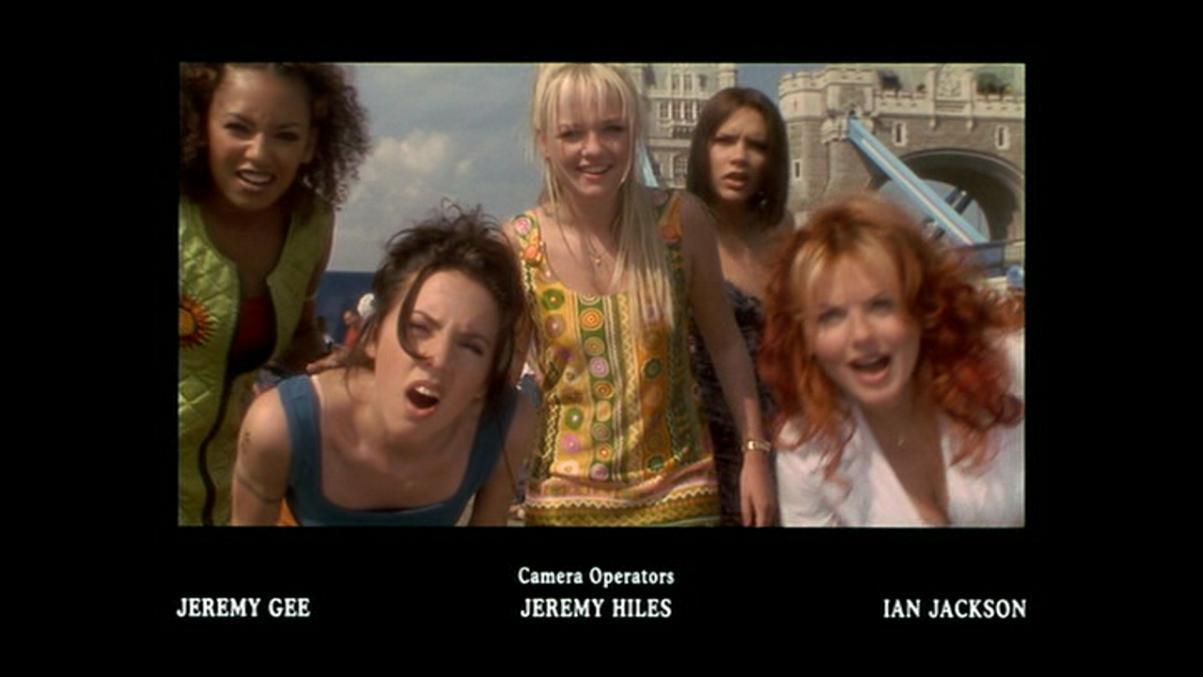
Spice World

Spice World
December 15, 1997
Columbia
Musical, Comedy
VHS
C+

This movie has of course dated badly, but let me first offer you some background on where I'm coming from, because my criticisms are probably not the usual ones.  My housemate of the time (still one of my dearest friends) was then a 21-year-old gay man who loved the Spice Girls and he'd play their music a lot.  Since I like pop music, I soon grew to like them.  I was never a great fan, but I could tell them apart.  (Well, to this day I can't remember which is Mel B. and which Mel C., but I knew their Spice identities.)  He, I, and another of his besties went to see this movie.  At almost 30, I was the oldest woman there who wasn't accompanied by a preteen daughter.  We had a blast, with the goofiness and the music.

Watching it now, when the Girls breaking up is no longer a plot complication and it's hard to remember their international popularity, what's left is a movie that did not exactly do for the Spices what A Hard Day's Night did for the Beatles one-third of a century earlier.  I want to like this movie more, at least on a camp level, but the problem is that it does not in fact present a "Spice World."  They don't dominate the screen like the Beatles did.  There are too many sideplots and side characters, with the girls offscreen too much of the time.  Even when we get to see them perform or joke around, there are too many interruptions and cuts away.  And there's a scene where the girls play dress-up, as each other and as various female icons, but much of the impact is lost when I can't tell most of them apart in long-shot.  I will say that the music remains catchy, but I'd rather watch a set of their videos, where their energy isn't thwarted as it is here.

There are lots and lots of cameos, most of them wasted, e.g. Roger Moore doing a Blofeld satire that seems feeble after Dr. Evil.  Jonathan Ross plays himself, as he did in The Tall Guy, but that's pretty meaningless to an American.  And having Barry Humphries appear out of Dame Edna Everage drag seems a little pointless.  (This is 19 years after his brief appearance in Sgt. Pepper by the way.)  On the other hand, I realize that most people don't care that I was happy to see Neil Mullarkey show up, even if it's just for one line.  Bob Hoskins is in a brief sight gag, pretending to be Ginger.  (Don't ask.)  Elvis Costello appears 18 years after Americathon, but much more briefly.

Another Americathon survivor, Meat Loaf, is, no, not a roadie, but a bus driver for the Spices.  Alan Cumming, who's usually entertainingly awkward (as he was in Emma and Romy & Michele, and as he would be again in Josie and the Pussycats), is just awkward here.  Hugh Laurie does the best he can in one scene as Poirot (where Baby Spice gets away with murder), but his old friend Stephen Fry almost steals the movie in his scene as a stern judge.

Note, the joke about a potential Clinton scandal of him tucking his shirt into his underwear became ironic by the time this film hit America.

Like animals in the zoo, as baffled by us as we are by them.


Thursday, April 2, 2015

Sense and Sensibility

Sense and Sensibility
January 26, 1996
Columbia
Comedy, Drama, Romance, Historical
DVD
B+

My review of the book is here:  http://rereadingeverybookiown.blogspot.com/2011/12/sense-and-sensibility.html.  On balance, I think the movie and book are equal, for reasons I discuss there.  So let me just mention a few things, I didn't cover before, in particular, the casting.  As you can see, I've tagged a heck of a lot of people, three of whom were in Peter's Friends:  Emma Thompson of course, and Hugh Laurie & Imelda Staunton, again playing a married couple, although their height difference is used for more comic effect here.  Everyone of the tagged performers, except the two Hughs and Imogen Stubbs (who is Lucy here and would shortly appear in Twelfth Night with Imelda Staunton), would be in at least one Harry Potter movie, while Grant and Jones would be in both Bridget Jones movies.

This cast cosiness adds to the feel of the movie, which is, as it title suggests, very much about thoughts and feelings.   (And Thompson, whose marriage to Kenneth Branagh was breaking up at the time, would find love with Greg Wise, who plays Willoughby here.)  With the female side of the Dashwood family in particular (Jones, Thompson, Kate Winslet, and a quite good Emilie François as Margaret), we see how much they care, not in a corny way but as if the family is central to their identities, romances aside.  Watch for instance how Edward's proposal is told not through Thompson and Grant but through the reactions of her mother and sisters.  Meanwhile, Alan Rickman gives a performance throughout the film that is more about what he doesn't say than what he does.  (And he already has developed the Snapian pauses by the way.)

The other thing I really appreciated this go-round was the scenery.  It's not as lovely as Italy in Enchanted April, but in its own understated way England (Devonshire especially) is figurative as well as literal background to the mood of the story.

Sunday, March 1, 2015

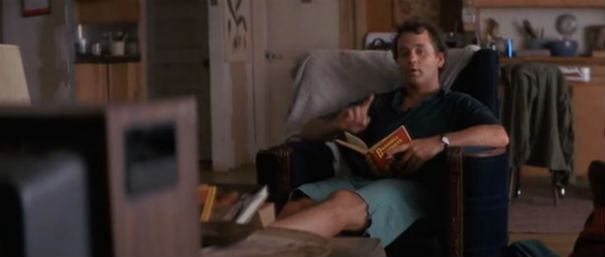
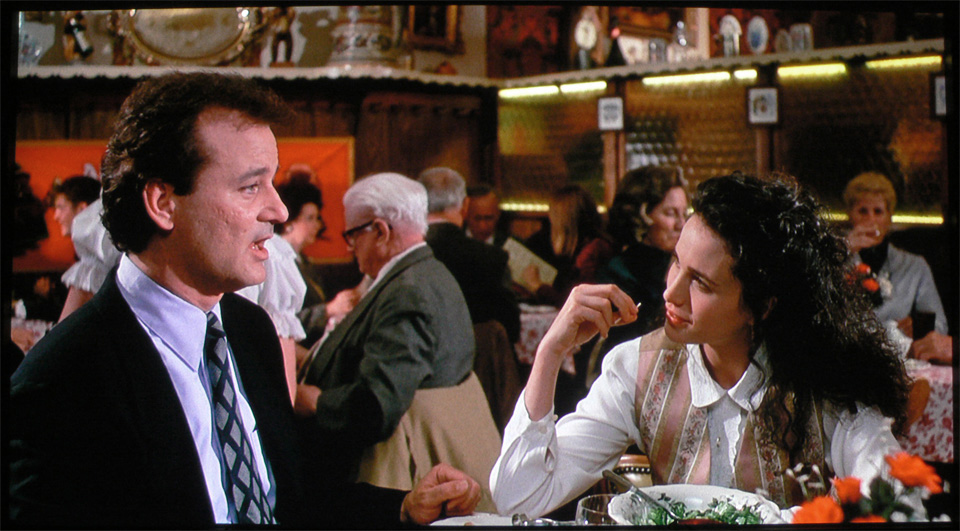
Groundhog Day

Groundhog Day
February 12, 1993
Columbia
Comedy, Romance, Sci-Fi
DVD
A

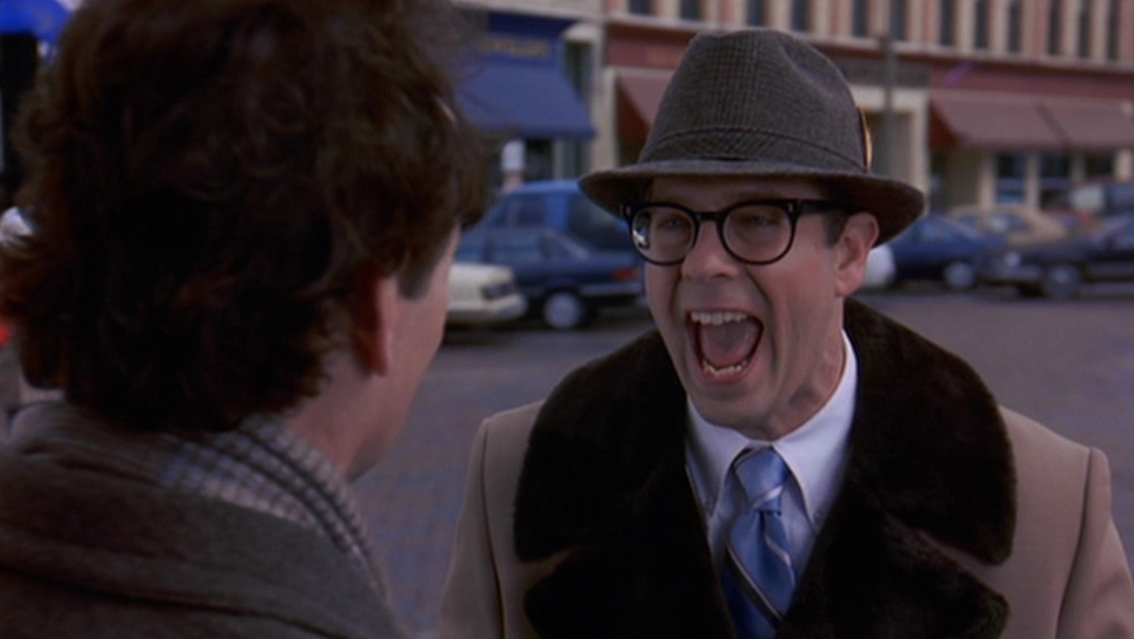
This is a modern classic, the only movie I can think of that is on a level with Some Like It Hot.  Like that Billy Wilder movie, this Harold-Ramis-directed-and-cowritten movie has wonderful leads and great supporting players.  (Stephen Tobolowsky is the clear stand-out, as adorably obnoxious Ned Ryerson, but I also enjoy all the little touches Robin Duke adds to her role of Doris the waitress.)  This movie also shares with Wilder, and with Preston Sturges, a successful blend of cynicism and sentiment, although I think this '90s film is ironically much more positive about human nature than many older films.  It goes dark at times-- including in a funny but disturbing suicide montage-- but it also argues that even the most self-centered, miserable man can change his life and the lives of others, if given enough time.

The movie is obviously about time, how it can be an enemy or an ally.  I wasn't sure whether to go with sci-fi or fantasy as the label for one of the film's genres (comedy and romance were easy), because we're never given a definite reason why weatherman Phil Connors keeps repeating the same February 2nd.  There are many theories out there, ranging from the Magical Negro Bartender with his knowing looks to a whack on the head with a snow shovel.  I decided that a time warp is more of a science fiction motif than fantasy, but in the end it doesn't really matter why it happens.  It just matters what Phil does with it.

He does a lot with it, some of it illegal and immoral and fattening, and some of it uplifting.  Over time, Phil falls for his producer Rita and has to figure out how to win her.  He can't just manipulate her, like he does with other women.  She's too smart for that.  So he becomes a better person in every way.

I can't think of any movie that is so simultaneously funny and thought-provoking.  It appropriately improves on repeat viewings.  You know what's coming but you need to see it play out, watch all the variations.  Also, you grow fond of the town, as Phil does, with its Sturges-like eccentrics.

Bill Murray is perfectly cast as Phil, because, as Ramis points out on the commentary, he's got that blend of sweet and nasty.  Also, his ability to improvise serves Phil as well as the humor.  I've never been 100% happy with Andie MacDowell as Rita, but she's grown on me, and this last viewing I appreciated her little reactions when she's not the focus of attention.   I'm not sure if she's why I can't give the film an A+.  I guess a hypothetical A+ movie would have to have all the qualities of both this and Some Like It Hot, like a more memorable soundtrack here.  (Though the Ramis-penned "Weatherman" is cute.)

Bill's big brother Brian Doyle-Murray plays Buster, "the head groundhog honcho."  Rick Overton, who's Ralph here, was Dr. Rick in Earth Girls Are Easy.

Reni Santoni, whose voice was dubbed for the State Trooper, would be a Police Officer in The Brady Bunch Movie.  One of the Flat Tire Ladies, Barbara Ann Grimes, would be Mrs. Cardoza in The Hudsucker Proxy.  Stephen Detherage, who's a News Intern here, would be Al the Concert Shirt Vendor in Music and Lyrics.

Thursday, January 29, 2015

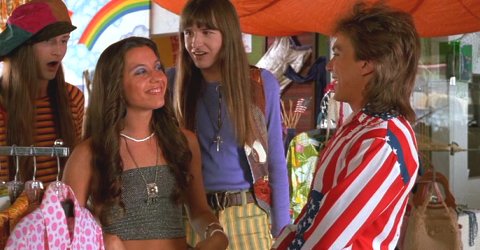
The Spirit of '76

The Spirit of '76
October 12, 1990
Columbia
Comedy, Sci-Fi, Historical
DVD
B-

This is even more of a decade-straddler than its peers, since not only was it filmed in the summer of 1989, but it's mostly set in the summer of 1976.  If this sounds a little early for '70s nostalgia, you're correct.  The film was made for a low budget and didn't make much back.  Even "writer 'n director" Lucas Reiner (son of Carl, who plays Dr. Von Mobil, and little brother of Rob, who is the est-like Dr. Cash) admits on the commentary that they should've waited at least another four or five years.  By the mid-'90s, The Brady Bunch hit the big screen, twice, and before long That '70s Show became very popular on the little screen.

The slight premise, in a not quite rip-off of Bill & Ted, is that three people from 2176 (played by David Cassidy, Wonder Years' Olivia d'Abo, and Geoff Hoyle, who was Scoop the Reporter in Popeye) use a time machine (made out of two hot tubs, much more '70s than B & T's phone booth) to go to 1776 and rediscover what America was founded on, but the machine malfunctions by a couple centuries.  Luckily, it's the Fourth of July, and the Bicentennial, and Julie Brown as "lusty Miss Liberty" is among those who "explain" the founding principles.

The movie is full of '70s touches.  In fact, it's arguably all style and not much substance.  There's enough to look at and listen to that you probably won't much mind.  From Pop Rocks to pop music, much of what you remember (or at least have heard of) about the '70s is represented, including very colorful costumes designed by a teenaged Sofia Coppola.  There are also a lot of cameos, from people I associate more with the '80s (Devo, Moon Unit Zappa) to authentically '70s icons like Iron Eyes Cody and Leif Garrett, the latter in a scene-stealing role as "Eddie Trojan," brother to the insufferable Rodney Snodgrass (played by nobody you've heard of).  There are moments when L. Reiner parodies various '70s movie conventions, like the Inevitable Car Chase, but the movie remains more goofy than clever.

Note, the sci-fi is, per budget, not particularly well done, but it is fun to see the hand-held devices that the futuristic trio use to type, call, and take pictures with.  Who knew?

Arnold F. Turner, who's Voice Talent here, would be Officer Axelrod in The Brady Bunch Movie.

Saturday, January 3, 2015

The New Adventures of Pippi Longstocking

Annika's not even whiny!  And, no, that's not a plus.
The New Adventures of Pippi Longstocking
July 29, 1988
Columbia
Children's, Comedy, Musical, Fantasy
VHS
C-

Maybe it's generational bias, but I just can't get into this late '80s take compared to the badly dubbed but endearing European imports of my childhood.  The thing is, although this claims to be "new," there are a lot more adventures recycled from the Inger Nilsson series than from the books.  I'm pretty sure the cows eating Tommy and Annika's clothing only happens in Pippi on the Run, not to mention the appearance of that movie's "glue man" character, here played by Dick Van Patten.  What is new in this version includes things of dubious value: lots of songs, or rather a handful of songs repeated ad nauseam; a setting that's vaguely Florida in the Truman era; and Pippi facing setbacks that make me think Irving Thalberg came back from the dead and advised Ken Annakin.  The Pirate Movie director wrote and directed this, and we can see such PM touches as beefcake (Hello, Fridolf!), talking animals (one voiced by Frank Welker), an ice-cream salesman, and of course pirates.

The Thalbergization is seen in the way the title character (played by relatively over-the-hill but eager thirteen-year-old Tami Erin) is handled.  Yes, she still has strength, spunk, and magic powers, but she twice shows fear, something the book's Pippi (and of course Nilsson's) never did.  Worse than that, while the Pippi of twenty years ago successfully fended off the threats of robbers and a children's home, this Pippi ends up in an orphanage (run by Eileen Brennan, who can't decide if she's auditioning for Annie or playing a well-meaning overworked social worker).  There's an interwoven thread about evil real-estate developers (hey, things had changed in Florida in the 60 years since Cocoanuts) wanting Pippi's house.  Oh, and this was what really sunk the movie for me: even though Pippi has her traditional interest in art, she never brightens up Villa Villekulla when she gets out her painting supplies, and it remains drab and gray.

All that said, I don't hate this movie.  It's harmless enough, especially for kids under the age of maybe 9.

Tuesday, December 16, 2014

Roxanne

Roxanne
June 19, 1987
Columbia
Comedy, Romance
VHS
B-

As with All of Me (1984), I enjoyed this Steve Martin movie more at the time, although it's still a pretty good movie.  The setting (Nelson, BC passing as Nelson, WA) is lovely, a little mountain town with Victorian houses.  The romantic triangle (based on the play of course) generally works, even if there are times it's a bit implausible that someone as bright as the title character is supposed to be (played by Daryl Hannah) doesn't figure out the deception sooner.  Shelley Duvall, as Martin's "godsister" Dixie (I guess her mom was his godmother, or a similar situation), gives a good supporting performance as friend to both CD and Roxanne, with a life of her own.  The third side of the triangle gets his own happy ending with a character who has been established early on.  I can't think of anything seriously wrong with the movie, other than that a lot of the firefighter slapstick doesn't hold up.  (There is one nice sight gag out a window.)  It's a pleasant enough movie but I think ultimately forgettable.

This time, Fred Willard plays Mayor Deebs, who of course (like all Willard characters) frequently puts his foot in his mouth and doesn't notice.  Matt Lattanzi, who plays Trent, was Brad (and thus a subject of a song) in Grease 2.  We get early and small but instantly recognizable appearances by two men who'd go on to comedy success, particularly on the little screen: then 33-year-old Kevin Nealon as a drunk and then 26-year-old Damon Wayans as a fireman.

"You don't have to wear that dress tonight."

Saturday, December 13, 2014

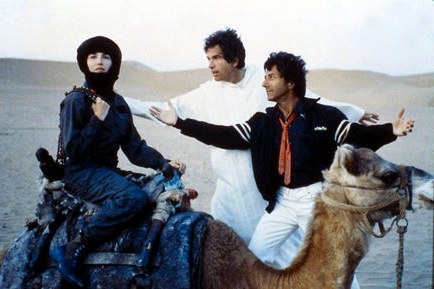
Ishtar

Ishtar
May 15, 1987
Columbia
Comedy, Action
VHS
C-

This isn't as terrible as you've heard, but that's not saying much.  It starts out fine, with Dustin Hoffman and Warren Beatty as two talentless musicians who dream of the big time.  (Hoffman thinks they can surpass Simon & Garfunkel, a nice little sort of reference to Hoffman's break-through movie, directed by Elaine May's former comedy partner, Mike Nichols.)  The songs, mostly cowritten by Ms. May and Paul Williams, are so bad they're good.  But then writer-director May, in the form of the guys' agent, played by Jack Weston (27 years after Please Don't Eat the Daisies) sends them to the title country, on the border of Morocco.  And I lose almost all interest in the movie.

In a way, May was trying to make an '80s answer to the Road to movies, but she set this in sort of the real world.  (Hoffman thinks Kaddafy is another country.)  And there's none of the fourth-wall-breaking we got with Bob and Bing.  Also, their Dorothy Lamour is a left-wing revolutionary who flashes her breasts when she's pretending to be a boy.  May could've done some astute political satire (this was released in the midst of Iran-Contra after all), but what we get is no sharper, or funnier, than in Warren's sister's John Goldfarb.  Also, if I can't decide whether I wish there was more of Carol Kane or I'm grateful for her sake that her character breaks up with Hoffman's and disappears from the movie, that's not a good thing.  Even the whole reversed expectations of Beatty being a loser with women doesn't really have any kind of pay-off.

My advice: watch the first twenty minutes or so and then maybe the last three.  (If you need to see Isabelle Adjani's breasts, they're fairly early on.)

Fred Melamed had small roles in both Hannah and Her Sisters and Radio Days, and here he plays Caid of Assari.  Bill Moor plays U.S. Consul here and would be Duke Vermont in Tune in Tomorrow....

Thursday, October 9, 2014

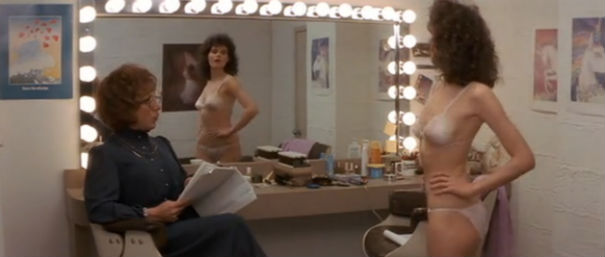
Tootsie

Tootsie
December 17, 1982
Columbia
Comedy, Romance
DVD
B+

Late in the movie, Jessica Lange's Julie tells one of Dustin Hoffman's characters, "I love you but I can't love you."  I think that sums up how I feel about this movie.  I've treasured it since I first saw it at 14, but I don't think it holds up quite as well as Nine to Five does.  Ironically, this is because it's a farce that plays out realistically, while 9to5 is a farce that is inspired by real-life issues but exaggerated on a grand scale.  9to5 ends just as it should, with every character getting what he or she deserves; while Tootsie's ending abandons characters we've grown to care about.

Like 9to5, this was a huge hit and remains a "comedy classic."  But just in case you don't know or have forgotten the situation, here we go:  Forty-five-year-old Dustin Hoffman plays Michael Dorsey, an actor who doesn't have Hoffman's success but does have Hoffman's pain-in-the-ass-ness.  His agent George Fields, played by the film's director Sydney Pollack, tells him no one will hire him.  So out of a desperation that's somewhere between Joe & Jerry running from the mob in Some Like It Hot and Kip & Henry needing an apartment in the early '80s sitcom Bosom Buddies, Michael passes himself off as Dorothy Michaels, a sweet but tough Southerner, in order to get a role on a soap opera.  He succeeds but, yes, complications ensue.  Some of these are romantic, with Michael bedding his long-time friend Sandy (Teri Garr) but falling for Julie, meanwhile attracting the attentions of the lecherous male lead on the soap (George Gaynes) and of Julie's old-fashioned but good-hearted father Les (Charles Durning).  Julie is involved with the soap's director Ron, whom, since he's played by Dabney Coleman, we know is going to be, as Dorothy puts it, "a macho shithead."  Roommate Jeff (Bill Murray) is the only one besides George who's in on Michael's secret.  When everything is a mess, including that Dorothy's contract is going to be extended, Michael decides to reveal his gender, on national television!  (No, it doesn't get explicit, it's enough for him to take off his wig.)  This doesn't exactly improve any of the situations, so he has to deal with the fall-out.

I have to say, the cast is wonderful:

  • Hoffman shines in all four roles (Michael, Dorothy, her soap character Emily, and briefly Emily's brother Edward).  Dorothy in particular is a memorable, likable, and even believable character.  We agree with Julie at the end when she says she misses Dorothy.
  • Jessica Lange got an Oscar for this movie, as a consolation prize for not winning the Lead Actress in Frances.  She's one of the few characters who's not there for humor, instead bringing sweetness and wistfulness to the part.
  • Teri Garr was also nominated for Supporting Actress, with more grounds.  She manages to pull off the insecure role without getting annoying.  (It's not unlike Diane Keaton's Annie Hall, although we never get to see her come into her own, as Annie does.)
  • Bill Murray is a scene-stealer with his partially improvised role.  Whether he's doing one-liners about his roommate's drag or pontificating on the meaning of The Theatre, he's great!
  • Sydney Pollack is spot on as the agent, with so many good lines, the popular "a tomato doesn't have logic" one possibly the best.  In a different way than Murray, he provides a crazy New-York-y kind of sanity to contrast with Michael's dead-serious outrageousness.
  • The supporting cast are solid, with Coleman playing Ron as more intelligent and less crude than Mr. Hart but still "sexist, egotistical, lying, and hypocritical" (although not bigoted per se).  Special praise goes to 26-year-old Geena Davis as April, making her debut in what was just supposed to be a role for a tall actress whose "tits" would line up with Hoffman's eyes, but she adds what would later be recognizable as a Geena Davis specialty, that wide-eyed quirkiness.

The two Stephen Bishop songs, the droll title tune and the love song "It Might Be You," are both used twice, which might be a bit much but they work all those times and add to the moods of their respective scenes.  The costumes are less memorable than you'd expect, except for some of the garb Dorothy wears during the photo-shoot montage.  The sets are workman-like, not really calling attention to themselves, except when the walls of "Emily's party scene" match her dress.

The main weakness is the script, which I realize sounds funny because in some ways this is one of the best comedy scripts ever.  But it's that darn ending.  And I'm going to try to distinguish between what is my Teri Garr bias, and related Michael/Sandy shipping over Michael/Julie shipping, vs. the need for a full resolution.  I don't have anything against Jessica Lange, and she is lovely here, and I totally believe that Michael would fall for her.  However, I'm more drawn to the Teri Garr type (personality and looks), and the truth is we see her with Michael, including the before & after of their bedding, while with Michael and Julie we only see him "being a better man with her as a woman" etc.  Michael doesn't have to end up with Sandy, but we don't see him making amends to her, as we do with Les, whom he has hurt and betrayed much less (no pun intended).

Michael tells his agent, "These are good people," meaning he doesn't like deceiving them, but Julie and Les aren't the only people he's hurt.  There's no real closure to the Sandy thread, other than she decides to go ahead and do Jeff's play with Michael, as planned.  And after his classic "That is one nutty hospital" line, Jeff disappears from the movie, too.  I like the scene of Michael pushing over the mime, and I do like his scenes with Les and Julie, but the fact is the movie feels incomplete.  If it hadn't made me invested in the characters, I wouldn't feel so let down.  Even with Julie, I can only accept her forgiving him because one, she and Dorothy really did become best friends, and two, we know she's used to making bad choices about men.  Let's hope that this time she will, as Jerry told Sugar Kane, get the sweet end of the lollipop.

Richard Whiting, who plays a priest here, would be "Other Doctor" in Zelig the next year.  Anne Shropshire, who plays the scary nanny Mrs. Crawley, would be " ' A Certain Age' Cast Member" in The First Wives Club.  Elaine May did then uncredited work on the script (including giving Michael a sounding-board roomie) and would reunite with Hoffman later in the '80s for the infamous Ishtar.


Wednesday, July 16, 2014

Thank God It's Friday

Thank God It's Friday
May 19, 1978
Columbia
Comedy, Musical
VHS
C

This plays like one of the more forgettable episodes of The Love Boat, only with casual drug use and of course a disco setting.  There are different plot threads and characters, many of them involving romance, and they only somewhat overlap.  None of them is particularly interesting, and I can only recommend this movie for maybe half a dozen decent to good songs and a chance to spot a handful of people who went on to better things, notably Fame's Valerie Landsburg (playing a teen who's supposed to be a marvelous dancer, although we can't really tell from the brief sample) and poor Debra Winger, as a nice girl looking for a nice guy.

And there's Jeff Goldblum, still only 25 at that point, but looking older and reptilian as the sleazy owner of the Zoo disco.  His character tries to seduce Sue, played by Andrea Howard, who'd be the love interest in The Nude Bomb.  Her husband Dave is played by Mark Lonow, who'd be a Father of the Bride in The Wedding Singer.  

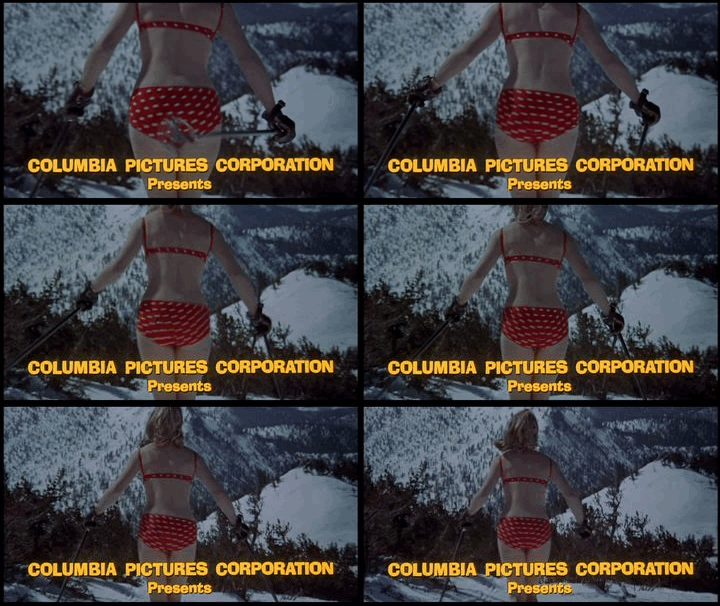
As for the music, Donna Summer sings the Oscar-winning "Last Dance" and three other songs, and the Commodores sing "Hot to Trot" and the classic "She's a Brick House."  Just about everything else is forgettable, except for the over-the-top title track, which makes the Columbia lady boogie down.

Phil Adams, who's Tarzan here, would be a "hood" in C.H.O.M.P.S.  Wade Collings would also dance in Can't Stop the Music.  MacIntyre Dixon, a bartender here, would have a more substantial role, as Cole Oyl in Popeye.  Paul Jabara, who plays Carl and performs (on the soundtrack rather than as Carl) "Disco Queen" and "Trapped in a Stairway," wrote not only "Last Dance" but "It's Raining Men," which plays in Bridget Jones's Diary among other movies.

Director Robert Klane went on to the Weekend at Bernie's movies, which I don't own.

Tuesday, May 20, 2014

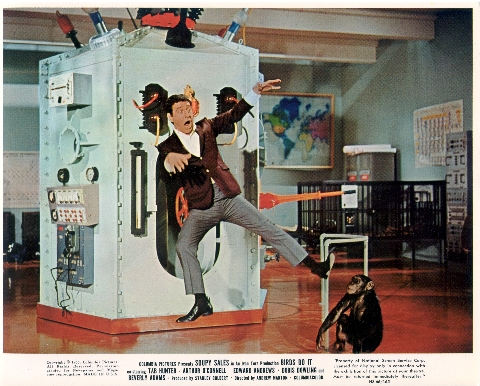
Birds Do It

Birds Do It
August 1966
Columbia
Comedy, Sci-Fi
VHS
C+

Although it has potential to at least be silly fun, this movie about a gravity-defying Soupy Sales never, well, quite gets off the ground.  Besides Soupy, it's got a chimp, Arthur O'Connell as a somewhat befuddled scientist, Beverly Adams as his science-protesting daughter who throws parties where her friends dance to the non-Cole-Porter title tune and the weather, Tab Hunter in a dual role as an idiot and a villain, a man-hating turned man-hungry Congresswoman, and an inflatable horse.  But there are too many unresolved plot points (even for a farce) and there are cameos by Dean Martin and Groucho Marx which give neither star much to do (Flipper's presence is explained by Ivan Tors as producer), not to mention a lame parody of the yacht scene from Some Like It Hot.  I'd still be inclined to give the movie a B-, but the Melvin-floating-over-Lover's-Bay sequence goes on far too long.

Courtney Brown, Arno here, would be Carrie in Speedway.  Jay Laskay, who plays Willie, would be Philo in Hello Down There.  Julian Voloshin, who's Prof. Nep, would be "old man in fishing boat" in Super Fuzz. 


Wednesday, May 14, 2014

Winter A-Go-Go

Winter A-Go-Go
October 28, 1965
Columbia
Comedy, Drama, Musical
VHS
C

I was thinking of giving this a C, like Ski Party, before we got to the character of the giggling Chinese cook.  And while the sexism isn't as hostile as in Ski P, the interview question of a girl's measurements has dated in a bad way.  But the movie was saved from a C- by an increase in funny drama.  You know the kind, where characters have lines like "You're a great girl and maybe someday you'll be the real you and get over whatever's hurting you inside."  Or this double-entendrous exchange (I'm paraphrasing since I don't take notes)--
VILLAIN: You can get hurt playing both sides of the fence.
REFORMED HENCHMAN: I like to go where the action is.
VILLAIN: Well, you're fooling around with the wrong guy.

It's pretty sad when the Nooney Rickett Four are your most famous musical act, other than the Hondells, who, yes, sing the theme song with it's oh so '60s title.  One of the dance numbers, however, looks like the grandmother of "Jingle Bell Rock" in Mean Girls, the costumes especially.  As for the comedy, well, when a joke about "CA" for "Cokes Anonymous" is only funny because this is 17 years before Cocaine Anonymous was founded, well, I start to get impatient for the next dramatic scene.
GIRL #1: (during one of the fight scenes) They'll kill each other!
GIRL #2: I can't watch this!

There are, not surprisingly, some crossovers in the casts of AIP movies and Elvis movies.  Beverly Adams ("Jo") was Cassandra in How to Stuff a Wild Bikini.  Carey Foster was in Pajama Party.  Linda Rogers ("Penny") was the auburn-haired Mouse in the earlier Beach Party movies.  Nancy Czar ("Jonesy") was in Girl Happy and would be in Spinout, costarring with Arlene Charles again.  Julie Parrish ("Dee Dee") would be in Fireball 500.

Tuesday, April 22, 2014

Gidget Goes to Rome

Gidget Goes to Rome
August 7, 1963
Columbia
Comedy
VHS
C-

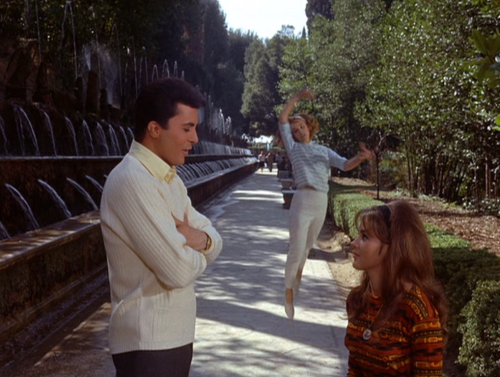
Released the same day as Beach Party, this is far inferior to not only the AIP series-starter, but to the previous Gidget movies.  The best thing about the movie is Don Porter in the first reel.  (He would also play Gidget's father, now a widower, in the Sally Field TV series a couple years later.)  Also, I do appreciate that they did extensive location shooting, and Rome does look good.  Unfortunately, there are these teens and post-teens cluttering the screen, too.

In the '90s comic Greg Proops would say of Luke 90210 Perry that he was "older than James Darren in the Gidget movies."  Darren was 27 by this point, and his character still has a year to go in college.  Gidget is now 18 and about to start college.  She remarks late in the movie that after visiting Rome she's "not the same person."  That's for sure!  Cindy Carol is the latest Gidget and, thanks to a script that Flippen unfortunately cowrote (rather than her soloing on Goes Hawaiian), and disappointing direction by Wendkos, C.C. plays the girl-midget as a sulky, sometimes crazy know-it-all who keeps getting into fixes that end up at the American Embassy.  (JFK's picture is on the wall, and the New York airport is still called Idlewild, a few months before the assassination.)  The two "steadies" have some moments together as a couple early on, but Jeff wants her to stop calling him Moondoggie.  (As if it wasn't a nickname from his surfer friends, rather than her!)  Soon though, he's flirting with their "Italian" (half-French) guide and dumping Gidget two years [sic] after pinning her.  He only goes back to her when the guide rejects his marriage proposal.  Meanwhile, Gidget "falls in love" with an older man, Paolo Cellini, not realizing that he's an old friend her dad asked to look after her.

The other characters aren't given much to do, although they seem to be trying really hard, especially the guests at the "international set" party.  If you feel the need to see this movie out of a sense of completeness, well, it's not too painful.

Peter Brooks, who plays Clay (the forgettable guy with the umbrella), would be in Girl Happy, as would Joby "Judge" Baker.  Cesare Danova, who's Paolo, would be Pepe Pepponi in Boy, Did I Get a Wrong Number!  Eddra Gale, who is "Fat Party Guest," would be in The Graduate.


"Yeah, and she hears voices and has delusions, too."

Friday, April 18, 2014

Gidget Goes Hawaiian

Gidget Goes Hawaiian
June 21, 1961
Columbia
Comedy, Musical
VHS
B+

This is an utterly delightful sequel, improving on the original in every regard.  No offence to Sandra Dee, but I think this is a great debut for Deborah Walley, then almost 20.  She could actually surf and this would be far from her last beach movie.  She's spunky in a different way than Dee, more obviously tomboyish, and she actually comes across as more innocent.  (Ironic, considering her AIP roles.)  She even has a bit of chemistry with James Darren, who stops being a jerk for the last 20 or 30 minutes of the movie.

Instead of just a triangle, we get a nine-sided group of teens and post-teens, with various pairings possible, although if the movie does have a weakness, it's that two of the guys and two of the girls are forgettable.  The other girl, Abby, is played by the deliciously feline Vicki Trickett.  (She's even scared of water, which pays off in her "punishment" at the end.)  Moondoggie's main rival is Michael Callan, playing a charming dancer, Eddie Horner.  (He gets saddled with a Broadway-Melody-Ballet-like number, but it's shorter and more bearable.)  Joby Baker actually plays a different character in this one (not just his nickname, since Judge has never met Gidget or Moondoggie before), and he adds to the hokey comedy.  Not that the film isn't genuinely funny much of the time.

It helps that Gidget's parents and Abby's are played by respectively Carl Reiner, Jeff Donnell (she nicknamed herself after "Mutt and Jeff," not after Moondoggie's birth name), Peggy Cass, and Eddie Foy, Jr.  They get a lot of screen time and they deserve it.  Not only do they all know how to make the most of out of their lines, but they manage to make Gidget's suspicions of wife-swapping plausible.  Yes, wife-swapping, although it's not called that.  She has a vivid imagination, and when Abby spreads rumors that Gidget sleeps around (not that it's called that), Gidget imagines herself as, in order, a streetwalker, a fan-dancer, and an unwed mother!  The movie is surprisingly outrageous, and even has jokes about suicide.  Yet it never comes across as sleazy.  Even when Moondoggie, Eddie, and Judge are singing the title tune and 'Doggie emphasizes, "When the Gidget goes Hawaiian, she goes Hawaiian all the way," it's suggestive, not tasteless.

This is the most fun movie of the '60s so far.  I will note in terms of continuity, that this is allegedly set the summer after the first movie, making Gidget almost 18.  Jeff pinning her is changed to this year rather than last.  I'll talk more about chronology when we get to Gidget Goes to Rome, also written by Ruth Brooks Flippen.

Donnell would return as Mrs. Lawrence for GG to Rome, but Foy would be "Beachgoer Wanting to Use Phone."  Don Edmonds, who plays forgettable guy Larry, would do Beach Ball.

Monday, April 14, 2014

Gidget

Gidget
April 10, 1959
Columbia
Comedy, Drama, Musical
VHS
B-

Almost 17-year-old Sandra Dee* plays the turning-17 title character (girl + midget).  This is the granddaddy of surf/beach movies, so we first see the-leads-surfing-against-rear-projection-waves mixed in with stunt surfers in long shots, and first hear a lot more talk about than practice of sex among the beach crowd.  This is based on the first of the Gidget books (which were in turn based on the author's daughter).  I've read only one of the books, and my review is here: http://rereadingeverybookiown.blogspot.com/2012/07/affairs-of-gidget.html.  The movies are apparently very different than the books, and I suspect the moral lessons that the mother gently passes on were not in the first novel.  When I first saw the movie in my early teens, I could relate to the pressure to have a boyfriend, and it wasn't till years later that it occurred to me that Gidget's boyish friend Betty Louise's initials may've stood for something else, fraternity pin or not.  Watching it now, I find Cliff Robertson a hell of a lot more attractive than cold fish James Darren, even when the latter is singing love songs.  Darren nonetheless would return as Moondoggie in the sequels, though the Gidgets would change.

Joby Baker is the only other member of the cast who would do the two film sequels, although his character's nickname would change from Stinky to Judge.  Paul Wendkos would stay on as director.  This film also features a 21-year-old Yvonne Craig (Batgirl) as one of Gidget's more buxom pals; and future Billy Jack, Tom Laughlin, as Loverboy.  Mary LaRoche, Gidget's sympathetic mom, would be in The Swinger.  (I don't own Bye Bye Birdie, but that's a very different Ann-Margret film she did.)  Four Preps member Bruce Belland would write "He's Gonna Make It" for The Barefoot Executive.  And, yes, orchestrator John Williams, Jr. is that John Williams.


*Dee's mother may have lied about Sandra's age, making her 15 in 1959.  In any case, she looks much younger than everyone else.


Sunday, March 2, 2014

His Girl Friday

His Girl Friday
January 18, 1940
Columbia
Comedy
VHS
B+

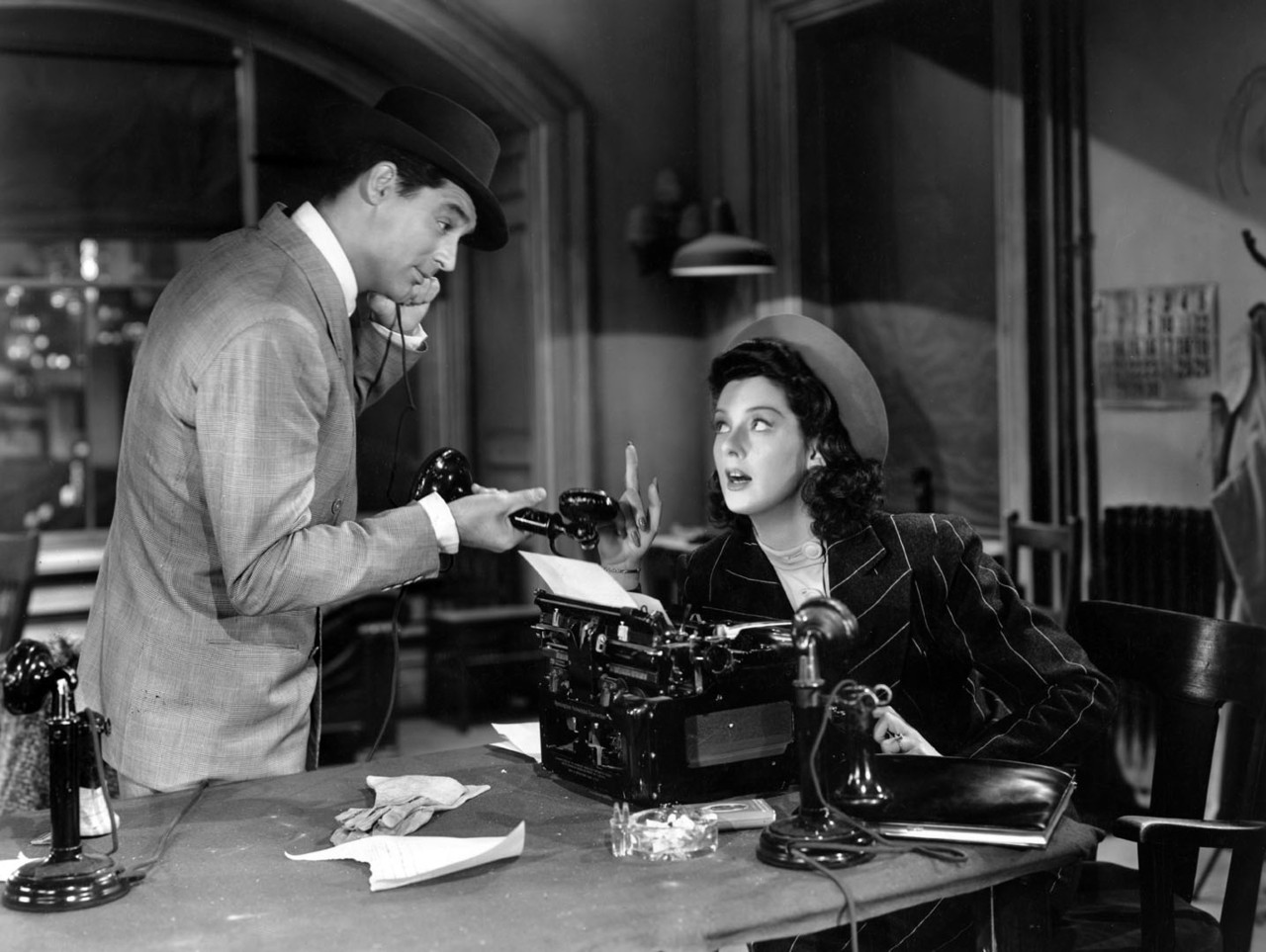
The '40s portion of my movie collection starts with a bang: this funny, fast-paced, smart, still controversial film.  Is the movie feminist or anti-feminist?  Is it racist or anti-racist?  And where does it stand on the death penalty?  It's tempting to say that it's not meant to be a message movie, that its ethics are no purer, its concerns no higher, than those of Walter Burns (Cary Grant), the charming but unscrupulous newspaper publisher who thinks a story about a rooster is "human interest," while "the European war" can be moved off the front page.  (And, yes, this is based on the play The Front Page.)  I think it is a very entertaining movie with a dark side that it hints at without fully exploring.  The reporters, even Hildy (played by Rosalind Russell), think a big story is more important than people.  The movie mocks them but also celebrates them.

Grant and Russell are wonderful together, with Ralph Bellamy as the never-a-real-challenge third side of the triangle, who gets taken advantage of because, well, he looks like Ralph Bellamy.  There are other third-wall-breaking jokes, like Grant's remark about "Archie Leach" and his calling someone a "mock turtle" (his role in the very odd 1933 version of Alice in Wonderland).  Grant and Russell ad-libbed a lot, and director Hawks encouraged them.  But other performers have their moments, mostly funny, although sometimes sad, as with Helen Mack as Mollie Malloy.  I would say, don't watch this expecting a perfect comedy-- it was #19 on the AFI list of 100 best comedies-- but give it a chance, and watch it more than once to really appreciate it.

Frank Orth, who plays Duffy, was the diner chef in At the Circus.  Frank Jenks was in You Can't Cheat an Honest Man.  Warden Pat Cooley would go on to The Bank Dick, Frank McClure to Citizen Kane.  Regis Toomey, who's Sanders, kept working into the 1980s, among other things playing a priest in Change of Habit (1969).