Showing posts with label Colin Higgins. Show all posts

Tuesday, September 9, 2014

Nine to Five

Nine to Five
December 19, 1980
Fox
Comedy
DVD
A-

I vaguely remember seeing The Nude Bomb at the time.  I definitely saw Popeye.  And I was among many who saw this movie, which was a smash hit that remains popular.  Changes in the office (technologically and otherwise) aside, this is still a joy to watch, from the sassy title theme by Dolly Parton, where even the metronomes bounce along, to the cheeky Where Are They Nows after the red-white-and-blue garbed heroines toast their success.

It's hard to know where to begin, so let's start with costumes.  When we first see mousy Judy Bernly (Jane Fonda), it's emerging from a crowd, looking not unlike Dustin Hoffman would in a similar scene in Tootsie a couple years later.  Lily Tomlin as no-nonsense Violet Newstead ad-libs a little later that they'll need a special locker for that hat.  The costumes, including hair and make-up, help tell the story, including Judy's dramatic evolution (with a fantasy sequence of her as a big-game hunter), but also, more subtly the ways that Parton, as the based-on-Dolly Doralee Rhodes, also becomes more assertive.  The supporting characters also look just right, like Elizabeth Wilson (Benjamin's mother in The Graduate) with her straight gray hair in the role of the spying Roz Keith, one of the many exaggerated but believable office types.  The best costume of all is of course the Snow-White fantasy dress for Violet (with its Skinny & Sweet/ Rid-o-Rat color-schemed skirt).

Those fantasies (and Doralee's "sexual harassment" revenge) work as humor but also are examples of how carefully crafted the script by director Colin Higgins and 27-year-old Patricia Resnick is.  Details resonate throughout the film.  The scarf that boss Franklin Hart (Dabney Coleman in the first of what would become his signature roles as likable assholes) makes Violet buy on her lunch hour, supposedly for his naive wife, is the gift that he gives to Doralee in his long failing attempt to seduce her (while spreading rumors in the office that she's his mistress), and Doralee rejects, only to have it be, well, a running gag that the women use to silence him more than once.  The film is full of Chekhov's guns turned into a shooting gallery, and it definitely works on later viewings.

Another thing to watch if you've seen it before is the reactions of those who aren't speaking.  Tomlin has the least cartoony role (despite her fantasy) so you may miss some of the subtle acting she does in this, one of her earliest big-screen roles.  There are moments when she's dealing with Hart and Roz where you know what she's thinking, but she's able to hide it from them.  Parton, in her very first movie, is just adorable, sweet but tough (the "wranglers" line and of course her infamous "rooster to a hen" line), and whimsical enough to throw in a Groucho impression.  Hart says that a chain is only as strong as its weakest link, which in this case is Jane Fonda, but when your weakest link is a two-time Oscar-winner, then you've got a very strong movie.  The three women have wonderful chemistry together (and remain good friends in real life), balancing each other so well.  If I have to pick one moment, it's the way Doralee calmly asks "Judy" and "Violet honey" to come take a look at the "wrong" corpse in the car trunk.

The humor ranges from verbal humor (like Violet's "murderess" line) to, no pun intended, broad physical humor, like Hart swinging from the ceiling not once, but twice.  It's actually funnier the second time, because Judy's helpfully named ex-husband Dick is downstairs, hoping to reconcile with her, until he finds out about the kinky "M & Ms" she practices.  The music plays up the comedy, and I could see that annoying people, but you just have to go with this movie.
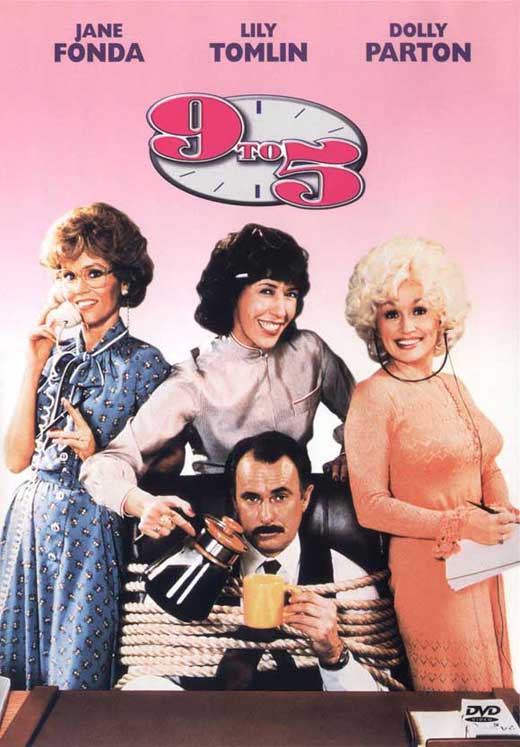
You don't have to be a feminist and/or a woman and/or an office worker to enjoy this film.  The theme of taking down The Man is something that almost anyone can relate to.  I like the touch that Hart isn't just a jerk to these three; he's a jerk to everyone, from other employees (including men) to his doting wife to the male doctor who looks at his concussion.  And yet, there's a moment very late in the movie when Violet says she "almost felt sorry for him."  Coleman gets the character just right, so that you like seeing him punished but you do feel a smidgen of sympathy for him.  It's also cool how, although he's not as smart as the trio, he's sneakier and he does come close to outsmarting them.  My favorite moment with him is when he tells Judy, after she's untied him, "I lied," and he picks up the phone to call the police, forgetting that Doralee has unplugged the phone.  The way the cord swings adds to the humor.

Higgins does a fine job of directing here, probably his best work, as the script is also his best.  Sadly, he would die of AIDS in '88, at age 47.  I'm thankful that he lived long enough to make this as well as Harold and Maude  and Foul Play.  I don't know if his being gay helped him relate to women better, but he certainly helped to bring such topics as sexual harassment and equal pay further into the mainstream, in a non-didactic way.  Progressive companies now offer on-site child care, flex time, substance abuse counseling*, and some of the other then utopian innovations that Violet, Judy, and Doralee manage (in six weeks!), but back in 1980, and throughout the decade, this film seemed awfully optimistic.

Helen Heigh gets a special Longevity Award, since she was the Hat Shop Owner in Easter Parade 32 years before playing Charlotte here.  A nice touch in casting is Henry Jones from Will Success Spoil Rock Hunter? as Hart's immediate boss.  Extras Elisabeth Fraser and Berniece Janssen were "Second Lady" in The Graduate and "2nd Wife" in The Love God? respectively.  Richard Stahl has a small but recognizable role as Meade.  Man at St. Ambrose Hospital Raymond O'Keefe was Bronco in Rabbit Test.  Ray Vitte was DJ Bobby Speed in Thank God It's Friday and he's Eddie Smith here.

Policeman Terrence McNally would be a Soap Opera Doctor in Earth Girls Are Easy.  Doctor Peter Hobbs was Dr. Dean in Sleeper and would be a veterinarian in Hot to Trot.


*I should talk about the "pot party" scene a bit.  Pot here is presented as benignly, if not more so, as alcohol.  Lulu got Jack stoned in Can't Stop the Music, but it was just for the sake of a sight gag when the Policeman village person showed up.  Here pot fuels the women's fantasies and bonding.  It is a sequence that is integral to the film, and yet it would've been unimaginable three or four years later in a mainstream hit movie, with the "Just Say No" movement, as well as John Belushi's 1982 overdose that shook up Hollywood, including Robin Williams.


Sunday, July 20, 2014

Foul Play

Foul Play
July 14, 1978
Paramount
Comedy, Mystery, Romance
DVD
B+

I saw this movie at the time, when I was 10, and even now watching the title sequence, with Barry Manilow singing "Ready to Take a Chance Again" (alternately belting it out and almost confiding it to us), as Goldie Hawn drives her little yellow VW Bug along the coast to San Francisco, gets to me in a way that no other title sequence does.  (I get shivers from "Hedwig's Theme" in every Harry Potter movie, but that has less to do with the visuals.)  Hawn plays an uncertain librarian, sometimes in big glasses, but there is the giggly Goldie side at some moments.  And yet, she's also thoroughly convincing as the "damsel in distress" who can sometimes rescue herself and try to solve the mystery of who's trying to kill her and why.  She furthermore has probably never looked so simultaneously beautiful and girl-next-door adorable.  She's well named Gloria Mundy, "glory of the world."

She's perfectly matched, comedically and romantically, with a post-Saturday Night Live Chevy Chase, at the peak of his looks, charm, and talent.  He plays a bumbling but clever cop named Tony, who's assigned to protect her, and there's a nice, very '70s moment, when she balances her feminism and her attraction to him.  He apologizes for his chauvinism, while still talking about her "ass," and they're more attracted than ever.  They have incredible chemistry together, such that I had to bump this up from a B to a B+.  I honestly can't think of a cuter film couple, but it's not just the way they look, but the way they talk and smile, and all they bring out in each other, like his sweetness and her mischief.  Interestingly, perhaps to keep the PG rating (despite the violence, drug use, and profanity, including the old ladies' dirty Scrabble game), we don't see Gloria and Tony do more than kiss, although it's very clear that they spend the night together at his place, and we see him wake up in just his jockey shorts.  The sex being offscreen allowed me to see this movie at such a tender age.

Meanwhile, however, there's the Stanley character played by Dudley Moore.  When Goldie needs a place to hide out, she approaches Stanley in a singles bar and asks him to take her home.  He of course thinks he's going to get lucky.  So while she's nervously peeking through binoculars-- "You're into that, too?"-- he gets his "pad" ready for a night to remember, with the Bee Gees' "Stayin' Alive" record, blow-up dolls, a stag-film projector, and a bed that is almost indescribable.  In these days of Internet porn and all-- I'm considering seeing an R-rated comedy called "Sex Tape" this week-- the pad may seem a lot less shocking than it did 36 years ago, but it's still very tacky, and unlikely to impress Gloria.  She's less outraged than puzzled when she looks away from the window, but their paths will cross again.

The funniest moments probably belong to Billy Barty as a "dwarf" Bible salesman that Hawn attacks when she thinks he's one of the bad guys.  Both the attack, and her hospital visit later that day, are played just right by both Barty and Hawn.  Burgess Meredith also does well, as Hawn's protective landlord with the laughing pet snake.  Chuck McCann has a brief bit as the owner of the revival theater where Gloria first witnesses a death.

The movie was written and directed by Colin Higgins, seven years after Harold and Maude.  (And not long after Silver Streak, which I haven't seen since the time.)  It is for the most part successful, although I do think the last half hour is the weakest, with an Obligatory '70s, not Chase Scene, but Rush to Save the Day Scene, that involves things like driving the wrong way on a one-way street, car crashes, and ethnic and other stereotypes (like Italians who exclaim, "Mama mia!").  And while there's more at stake at the Mikado production than there was in the Night at the Opera finale, I don't think this sequence works entirely.  Still, it's great at the very end to see Chevy & Goldie go from smooching (they are a great team of smoochers) to shrugging and taking bows, as Mr. Manilow proclaims he's ready to take a chance again.  (And I'm not even a Manilow fan, except here.)  Both Chase and Hawn are great reactors, separately and as a team.  Like the rest of the movie, they walk a balance between realism and cartoon.

So how's the movie as a mystery?  Well, it's certainly suspenseful, and I remember being really scared as a kid, especially of the albino, but there are a lot of moments of putting convenient clues together, and the cigarette pack with the microfilm in it (probably the most dated of many dated elements in the movie) turns out to be a complete McGuffin.  If you just apply the Gilligan's Island Rule of Broadcasting, then you know that the television news is repeatedly reporting that the Pope will be visiting San Francisco soon, and thus you know whom the villains want to assassinate.  (When Foul Play was first scheduled to be shown on TV in 1981, it had to be postponed because of the attempted assassination of Pope John Paul II.)  There are aspects that are homages to Hitchcock, some of which I get, some of which I don't.  I have the sense we're not meant to take the mystery entirely seriously, as when late in the film Tony says Gloria will have to identify the albino because she's the only one who's seen him and "he may be in disguise."  What, in colored contacts and a toupee?

Marc Lawrence, who plays Stiltskin ("The Dwarf"), would soon be another villain, Webster in Goin' Coconuts.  Rollin Moriyama and Mitsu Yashima, who play the Japanese couple in the taxi, would be Chinese in Americathon.  Marilyn Sokol, who plays Stella, would be Lulu in Can't Stop the Music.

Wednesday, June 18, 2014

Harold and Maude

Harold and Maude
December 20, 1971
Paramount
Comedy, Romance, Musical
DVD
B+

Thirty-year-old screenwriter Colin Higgins, 42-year-old director Hal Ashby, and 23-year-old Bud Cort (as almost 20-year-old Harold) and 75-year-old Ruth Gordon (as almost-80 Maude) brought their unique, quirky talents together to make this unique, quirky movie, ably supported by 40-year-old Vivian Pickles as Harold's fantastically pretentious, mostly unflappable mother.  This is a tricky film to talk about because it's become a Cult Movie, some people's favorite movie, and it's certainly meant a lot to me since I saw it at 19 on campus.  (They also showed Amarcord and a beach party movie, not all on one night.  It was a very confused film society.)  I think it's one of those not quite great movies.  I don't think everything in it works, like the way Maude keeps stealing cars, but it remains wise, sweet, sometimes joyous, and very funny.  I don't want to oversell it, because it's also in a way a quiet, little movie, with many long-distance shots and details to hunt out (like the PermaSeal on the coffin).  I think when you watch it, you have to get past its reputation and just enjoy it, because that's what Maude would want.

Ruth Gordon is just right as life-loving Maude, although I kept thinking She doesn't look 80, she barely looks 70.  Baby-faced Cort as Harold, despite his faked suicides, has a gentleness that is rare in movies, and when Maude brings him to life, he expresses it whimsically, as when he somersaults.  The script by Higgins is sharp and dry (he'd later pen Foul Play and 9 to 5, two other movies that mean a lot to me), while Ashby not only gets just the right emotions out of everyone (even the cartoony characters, like Harold's uncle), but he has some great shots, like the tombstones that look like a computer punch card from a distance.  And I must say that the Cat Stevens songs fit the movie perfectly, perhaps not as good as the Simon & Garfunkel music in The Graduate, but integrated even more effectively.

Marjorie Eaton, who was Miss Persimmon in Mary Poppins, this time plays Madame Arouet.  Michael L. Davis was Chief of Police in Skidoo and is unconfirmed as a policeman here.  Eric Christmas, who plays the priest disgusted by the idea of Harold's "firm young body" commingling with Maude's "withered" flesh, would be Senator Polk in Attack of the Killer Tomatoes!  Shari Summers, who plays Edith Phern (one of Harold's computer dates) would be a nurse in Who's That Girl?