December 19, 1980
Fox
Comedy
DVD
A-
I vaguely remember seeing The Nude Bomb at the time. I definitely saw Popeye. And I was among many who saw this movie, which was a smash hit that remains popular. Changes in the office (technologically and otherwise) aside, this is still a joy to watch, from the sassy title theme by Dolly Parton, where even the metronomes bounce along, to the cheeky Where Are They Nows after the red-white-and-blue garbed heroines toast their success.
It's hard to know where to begin, so let's start with costumes. When we first see mousy Judy Bernly (Jane Fonda), it's emerging from a crowd, looking not unlike Dustin Hoffman would in a similar scene in Tootsie a couple years later. Lily Tomlin as no-nonsense Violet Newstead ad-libs a little later that they'll need a special locker for that hat. The costumes, including hair and make-up, help tell the story, including Judy's dramatic evolution (with a fantasy sequence of her as a big-game hunter), but also, more subtly the ways that Parton, as the based-on-Dolly Doralee Rhodes, also becomes more assertive. The supporting characters also look just right, like Elizabeth Wilson (Benjamin's mother in The Graduate) with her straight gray hair in the role of the spying Roz Keith, one of the many exaggerated but believable office types. The best costume of all is of course the Snow-White fantasy dress for Violet (with its Skinny & Sweet/ Rid-o-Rat color-schemed skirt).
Those fantasies (and Doralee's "sexual harassment" revenge) work as humor but also are examples of how carefully crafted the script by director Colin Higgins and 27-year-old Patricia Resnick is. Details resonate throughout the film. The scarf that boss Franklin Hart (Dabney Coleman in the first of what would become his signature roles as likable assholes) makes Violet buy on her lunch hour, supposedly for his naive wife, is the gift that he gives to Doralee in his long failing attempt to seduce her (while spreading rumors in the office that she's his mistress), and Doralee rejects, only to have it be, well, a running gag that the women use to silence him more than once. The film is full of Chekhov's guns turned into a shooting gallery, and it definitely works on later viewings.
Another thing to watch if you've seen it before is the reactions of those who aren't speaking. Tomlin has the least cartoony role (despite her fantasy) so you may miss some of the subtle acting she does in this, one of her earliest big-screen roles. There are moments when she's dealing with Hart and Roz where you know what she's thinking, but she's able to hide it from them. Parton, in her very first movie, is just adorable, sweet but tough (the "wranglers" line and of course her infamous "rooster to a hen" line), and whimsical enough to throw in a Groucho impression. Hart says that a chain is only as strong as its weakest link, which in this case is Jane Fonda, but when your weakest link is a two-time Oscar-winner, then you've got a very strong movie. The three women have wonderful chemistry together (and remain good friends in real life), balancing each other so well. If I have to pick one moment, it's the way Doralee calmly asks "Judy" and "Violet honey" to come take a look at the "wrong" corpse in the car trunk.
The humor ranges from verbal humor (like Violet's "murderess" line) to, no pun intended, broad physical humor, like Hart swinging from the ceiling not once, but twice. It's actually funnier the second time, because Judy's helpfully named ex-husband Dick is downstairs, hoping to reconcile with her, until he finds out about the kinky "M & Ms" she practices. The music plays up the comedy, and I could see that annoying people, but you just have to go with this movie.
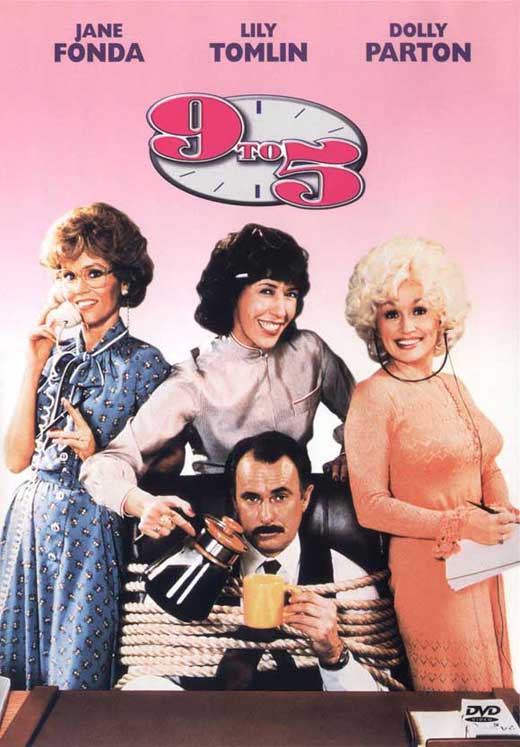 You don't have to be a feminist and/or a woman and/or an office worker to enjoy this film. The theme of taking down The Man is something that almost anyone can relate to. I like the touch that Hart isn't just a jerk to these three; he's a jerk to everyone, from other employees (including men) to his doting wife to the male doctor who looks at his concussion. And yet, there's a moment very late in the movie when Violet says she "almost felt sorry for him." Coleman gets the character just right, so that you like seeing him punished but you do feel a smidgen of sympathy for him. It's also cool how, although he's not as smart as the trio, he's sneakier and he does come close to outsmarting them. My favorite moment with him is when he tells Judy, after she's untied him, "I lied," and he picks up the phone to call the police, forgetting that Doralee has unplugged the phone. The way the cord swings adds to the humor.
Higgins does a fine job of directing here, probably his best work, as the script is also his best. Sadly, he would die of AIDS in '88, at age 47. I'm thankful that he lived long enough to make this as well as Harold and Maude and Foul Play. I don't know if his being gay helped him relate to women better, but he certainly helped to bring such topics as sexual harassment and equal pay further into the mainstream, in a non-didactic way. Progressive companies now offer on-site child care, flex time, substance abuse counseling*, and some of the other then utopian innovations that Violet, Judy, and Doralee manage (in six weeks!), but back in 1980, and throughout the decade, this film seemed awfully optimistic.
Helen Heigh gets a special Longevity Award, since she was the Hat Shop Owner in Easter Parade 32 years before playing Charlotte here. A nice touch in casting is Henry Jones from Will Success Spoil Rock Hunter? as Hart's immediate boss. Extras Elisabeth Fraser and Berniece Janssen were "Second Lady" in The Graduate and "2nd Wife" in The Love God? respectively. Richard Stahl has a small but recognizable role as Meade. Man at St. Ambrose Hospital Raymond O'Keefe was Bronco in Rabbit Test. Ray Vitte was DJ Bobby Speed in Thank God It's Friday and he's Eddie Smith here.
Policeman Terrence McNally would be a Soap Opera Doctor in Earth Girls Are Easy. Doctor Peter Hobbs was Dr. Dean in Sleeper and would be a veterinarian in Hot to Trot.
*I should talk about the "pot party" scene a bit. Pot here is presented as benignly, if not more so, as alcohol. Lulu got Jack stoned in Can't Stop the Music, but it was just for the sake of a sight gag when the Policeman village person showed up. Here pot fuels the women's fantasies and bonding. It is a sequence that is integral to the film, and yet it would've been unimaginable three or four years later in a mainstream hit movie, with the "Just Say No" movement, as well as John Belushi's 1982 overdose that shook up Hollywood, including Robin Williams.


