Showing posts with label A-. Show all posts

Thursday, August 6, 2015

Harry Potter and the Prisoner of Azkaban

Harry Potter and the Prisoner of Azkaban
June 4, 2004
Warner Bros.
Fantasy, Drama, Comedy
DVD
A-

The Harry Potter regulars this time include (*means newbie to the series):
  1. Peter Best as the Executioner*
  2. David Bradley as Argus Filch
  3. Robbie Coltrane as Rubeus Hagrid
  4. Violet Columbus as Girl With Flowers
  5. Warwick Davis as "Wizard" (see below)
  6. Alfred Enoch as Dean Thomas
  7. Tom Felton as Draco Malfoy
  8. Michael Gambon as Albus Dumbledore*
  9. Richard Griffiths as Uncle Vernon
  10. Rupert Grint as Ron Weasley
  11. Josh Herdman as Gregory Goyle
  12. Matthew Lewis as Neville Longbottom
  13. Harry Melling as Dudley Dursley
  14. Devon Murray as Seamus Finnegan
  15. Gary Oldman as Sirius Black*
  16. James Phelps as Fred Weasley
  17. Oliver Phelps as George Weasley
  18. Daniel Radcliffe as Harry Potter
  19. Chris Rankin as Percy Weasley
  20. Adrian Rawlins as James Potter
  21. Fiona Shaw as Aunt Petunia
  22. Geraldine Somerville as Lily Potter
  23. Timothy Spall as Peter Pettigrew*
  24. Danielle Tabor as Angelina Johnson
  25. David Thewlis as Remus Lupin*
  26. Mark Williams as Arthur Weasley
  27. Emma Watson as Hermione Granger
  28. Jamie Waylett as Vincent Crabbe
  29. Bonnie Wright as Ginny Weasley
In addition, Emma Thompson joins the cast as spacey Professor Trelawney.  (Which strengthens the Potter-Austen axis of course.)  This blend of old and new, including the shift of director Chris Columbus over to a producer role, so that the director's chair is filled by Alfonso Cuarón, really impacts the series.  As with Thompson's Sense & Sensibility, having a director whose first language is not English seems to both bring out the universality of what is a very British story and add an outsider's view.  

My review of the book is here
http://rereadingeverybookiown.blogspot.com/2013/11/harry-potter-and-prisoner-of-azkaban.html, but you'll note that I don't regard this as a children's movie in the way that that was a children's book.  This is very much a movie about a younger teen and his two best friends starting to really navigate their way through a more complex world.  The switch in directors also contributes to a less wide-eyed, warier tone.

As for that jump from B to A-, well, I thought then and continue to think that this is not only the best film in the series, but the only one that is on a level with The Wizard of Oz.  Everything is better-- the special effects, the acting, and the music in particular.  (Williams captures all the moods, from bittersweet to whimsical.)  Even the closing credits are much more creative than elsewhere in the series.

Radcliffe is making more effort, not always successfully ("HE WAS THEIR FRIEND" is notorious in fandom), but much better than under Columbus, while Grint and Watson continue to be solid, even as puberty complicates their bickering relationship.  And all the Gambon-bashers who are bitter about the loss of Richard Harris should take another look at his work here, which is much subtler and deeper than in the fourth film.  I also have to make special mention of Thewlis, who is just perfect as the avuncular but flawed Professor Lupin.  The only person who seems to be short-changed is poor Bonnie Wright with her one line as Ginny.  And the only one who is oddly treated is Warwick Davis, who apparently had nothing to do as Flitwick this time and so became the Choir Teacher, which would have a long-lasting effect on the appearance and to some degree character of Flitwick for the rest of the series, as I'll discuss under Goblet.

As for the special effects, it's partly that the CGI and other aspects had two and a half years to advance, but also that Cuarón and his crew are being more creative with them, as with the utterly believable Buckbeak, the Hippogriff who expresses everything from anger to affection to, well, defecation.

Interestingly, when I first saw the trailer for this entry, I had almost the opposite reaction to the trailer for the first.  I thought they'd really screwed up this time.  So it was a revelation when I saw the actual movie, which, yes, has a tone that takes some getting used to but is well worth the initial disorientation.  (And that the film starts with a tasteful masturbation joke was part of the surprise.)  I think the movie continues to hold up remarkably well, both within the series and as a stand-alone.  I was always disappointed that Cuarón did not return, but David Yates would make contributions of his own.  As for Mike Newell, well, stay tuned.


Sunday, February 15, 2015

Enchanted April

Enchanted April
April 5, 1992
Miramax
Comedy, Drama, Romance, Historical
VHS
A-

In reviewing the book on which this is based, http://rereadingeverybookiown.blogspot.com/2012/04/enchanted-april.html, I said that I'd probably give the movie a B+.  But on this, my first viewing in about four years, I found it was even better than I remembered.  Yes, I'm still not entirely satisfied with how the husbands are handled, but the film is nonetheless, as Lottie puts it, a tub of love.  I kept thinking the word "beautiful" again and again.  The movie was shot for television but then released for the big screen, and of course I watch it on TV, on one of three VHS tapes that my ex-husband and I made (we were both big fans), but you could probably watch it on a smart device and still see how lush the scenery is, how the women (even Mrs. Fisher) look like living, breathing paintings.

And the dialogue and narration are in turns sweet, funny, and heart-breaking.  It may well be the movie I own with the least action (even what would develop into a fight scene or a robbery in another story has a happy or at least comedic ending).  It's a reflective, vacation-like movie, and yet there is an undercurrent of sadness, with these characters hurt by loss of love.  Yet Spring means rebirth.

I came to this movie originally because of my fanhood of Josie Lawrence (physically but not spiritually miscast as Lottie).  She's quite lovable on the British comedy-game show Whose Line Is It Anyway?, and she's equally lovable here, although Lottie seems to have little in common with her, other than a tendency to say things she didn't intend to.  The rest of the cast is generally strong, but she still stands out as the heart of this movie.

Image result for enchanted april josieThis film is notable for beginning what I call the Three Degrees of Harry Potter and/or Jane Austen.  This is the rule that after a certain point, every British film has someone who was in a Jane Austen adaptation and/or a Harry Potter movie, or at least has someone who's a degree or two from someone who was.  Polly Walker (Lady Caroline) would show up in Emma, while director Mike Newell would helm Goblet of Fire, which has Miranda Richardson as the very un-Rose-Arbuthnot-like Rita Skeeter.  And Jim Broadbent, who's Rose's husband here, would appear as Professor Slughorn later in the series.


Tuesday, September 9, 2014

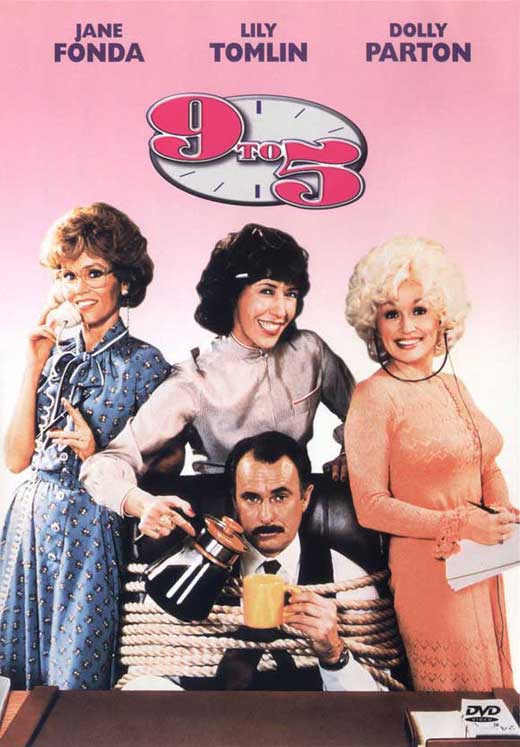
Nine to Five

Nine to Five
December 19, 1980
Fox
Comedy
DVD
A-

I vaguely remember seeing The Nude Bomb at the time.  I definitely saw Popeye.  And I was among many who saw this movie, which was a smash hit that remains popular.  Changes in the office (technologically and otherwise) aside, this is still a joy to watch, from the sassy title theme by Dolly Parton, where even the metronomes bounce along, to the cheeky Where Are They Nows after the red-white-and-blue garbed heroines toast their success.

It's hard to know where to begin, so let's start with costumes.  When we first see mousy Judy Bernly (Jane Fonda), it's emerging from a crowd, looking not unlike Dustin Hoffman would in a similar scene in Tootsie a couple years later.  Lily Tomlin as no-nonsense Violet Newstead ad-libs a little later that they'll need a special locker for that hat.  The costumes, including hair and make-up, help tell the story, including Judy's dramatic evolution (with a fantasy sequence of her as a big-game hunter), but also, more subtly the ways that Parton, as the based-on-Dolly Doralee Rhodes, also becomes more assertive.  The supporting characters also look just right, like Elizabeth Wilson (Benjamin's mother in The Graduate) with her straight gray hair in the role of the spying Roz Keith, one of the many exaggerated but believable office types.  The best costume of all is of course the Snow-White fantasy dress for Violet (with its Skinny & Sweet/ Rid-o-Rat color-schemed skirt).

Those fantasies (and Doralee's "sexual harassment" revenge) work as humor but also are examples of how carefully crafted the script by director Colin Higgins and 27-year-old Patricia Resnick is.  Details resonate throughout the film.  The scarf that boss Franklin Hart (Dabney Coleman in the first of what would become his signature roles as likable assholes) makes Violet buy on her lunch hour, supposedly for his naive wife, is the gift that he gives to Doralee in his long failing attempt to seduce her (while spreading rumors in the office that she's his mistress), and Doralee rejects, only to have it be, well, a running gag that the women use to silence him more than once.  The film is full of Chekhov's guns turned into a shooting gallery, and it definitely works on later viewings.

Another thing to watch if you've seen it before is the reactions of those who aren't speaking.  Tomlin has the least cartoony role (despite her fantasy) so you may miss some of the subtle acting she does in this, one of her earliest big-screen roles.  There are moments when she's dealing with Hart and Roz where you know what she's thinking, but she's able to hide it from them.  Parton, in her very first movie, is just adorable, sweet but tough (the "wranglers" line and of course her infamous "rooster to a hen" line), and whimsical enough to throw in a Groucho impression.  Hart says that a chain is only as strong as its weakest link, which in this case is Jane Fonda, but when your weakest link is a two-time Oscar-winner, then you've got a very strong movie.  The three women have wonderful chemistry together (and remain good friends in real life), balancing each other so well.  If I have to pick one moment, it's the way Doralee calmly asks "Judy" and "Violet honey" to come take a look at the "wrong" corpse in the car trunk.

The humor ranges from verbal humor (like Violet's "murderess" line) to, no pun intended, broad physical humor, like Hart swinging from the ceiling not once, but twice.  It's actually funnier the second time, because Judy's helpfully named ex-husband Dick is downstairs, hoping to reconcile with her, until he finds out about the kinky "M & Ms" she practices.  The music plays up the comedy, and I could see that annoying people, but you just have to go with this movie.

You don't have to be a feminist and/or a woman and/or an office worker to enjoy this film.  The theme of taking down The Man is something that almost anyone can relate to.  I like the touch that Hart isn't just a jerk to these three; he's a jerk to everyone, from other employees (including men) to his doting wife to the male doctor who looks at his concussion.  And yet, there's a moment very late in the movie when Violet says she "almost felt sorry for him."  Coleman gets the character just right, so that you like seeing him punished but you do feel a smidgen of sympathy for him.  It's also cool how, although he's not as smart as the trio, he's sneakier and he does come close to outsmarting them.  My favorite moment with him is when he tells Judy, after she's untied him, "I lied," and he picks up the phone to call the police, forgetting that Doralee has unplugged the phone.  The way the cord swings adds to the humor.

Higgins does a fine job of directing here, probably his best work, as the script is also his best.  Sadly, he would die of AIDS in '88, at age 47.  I'm thankful that he lived long enough to make this as well as Harold and Maude  and Foul Play.  I don't know if his being gay helped him relate to women better, but he certainly helped to bring such topics as sexual harassment and equal pay further into the mainstream, in a non-didactic way.  Progressive companies now offer on-site child care, flex time, substance abuse counseling*, and some of the other then utopian innovations that Violet, Judy, and Doralee manage (in six weeks!), but back in 1980, and throughout the decade, this film seemed awfully optimistic.

Helen Heigh gets a special Longevity Award, since she was the Hat Shop Owner in Easter Parade 32 years before playing Charlotte here.  A nice touch in casting is Henry Jones from Will Success Spoil Rock Hunter? as Hart's immediate boss.  Extras Elisabeth Fraser and Berniece Janssen were "Second Lady" in The Graduate and "2nd Wife" in The Love God? respectively.  Richard Stahl has a small but recognizable role as Meade.  Man at St. Ambrose Hospital Raymond O'Keefe was Bronco in Rabbit Test.  Ray Vitte was DJ Bobby Speed in Thank God It's Friday and he's Eddie Smith here.

Policeman Terrence McNally would be a Soap Opera Doctor in Earth Girls Are Easy.  Doctor Peter Hobbs was Dr. Dean in Sleeper and would be a veterinarian in Hot to Trot.


*I should talk about the "pot party" scene a bit.  Pot here is presented as benignly, if not more so, as alcohol.  Lulu got Jack stoned in Can't Stop the Music, but it was just for the sake of a sight gag when the Policeman village person showed up.  Here pot fuels the women's fantasies and bonding.  It is a sequence that is integral to the film, and yet it would've been unimaginable three or four years later in a mainstream hit movie, with the "Just Say No" movement, as well as John Belushi's 1982 overdose that shook up Hollywood, including Robin Williams.


Sunday, July 6, 2014

The Big Bus

The Big Bus
June 23, 1976
Paramount
Comedy, Action
VHS
A-

[ BIG BUS POSTER ]This note-perfect parody of '70s disaster movies is not only in my opinion much more enjoyable than the more famous and successful Airplane (1980), but it's the most fun I've had with any of my movies since Some Like It Hot.  It's partly that I'm a '70s kid and I love the bright colors and tackiness of this Ford-era movie, especially on the title vehicle, including the Bicentennial dining room.  But it really is dead on, from its David Shire score (as overwrought as anything in the Airport movies, but with whimsical touches like a sample from "Home Sweet Home" when the "flags of all nations" are raised to slow down the bus), to the dialogue, with such quotable lines as Joseph Bologna defensively exclaiming "You eat one lousy foot-- they call you a cannibal!", and a pre-Benson Rene Auberjonois as a doubting priest taunting Ruth Gordon, "Where's your god now, old woman?"  I also love all the exchanges between a pre-Soap Richard Mulligan and a post-MASH Sally Kellerman as a soon to be divorced couple, as well as Richard B. Shull (around the time of Holmes and Yo-Yo) hitting all the cliches in his "I wanna live" speech when Lynn Redgrave seduces him in a tub.

It's a very big bus, with a swimming pool, a bowling alley, and a piano bar where Murphy Dunne (who wrote his own material) anticipates Bill Murray's lounge singer by a year or so.  The bus is nuclear-powered and on a non-stop trip from New York to Denver, although the scenery is very obviously Californian, from the street with the Thrifty's to the mountains.  And, yes, very '70s, with the sodas that poor Stockard Channing almost drowns in including Fanta and Fresca.

She's wonderful, the whole cast is wonderful!  I haven't even mentioned Larry Hagman as the doctor who insists that Harold Gould (wounded by a St. Christopher's medal) can't be moved, or Ned Beatty and Howard Hesseman as the bickering technicians, or Jose Ferrer and Stuart Margolin as villainous brothers (despite being born almost 30 years apart), or Vic Tayback in a tiny plum of a role as a bus driver who gets in a broken milk carton vs. broken candle bar fight.

I spent most of the time grinning, when I wasn't giggling.  This viewing, I was struck by the fact that it actually works on a story level.  I mean it's not just gags, there's actually a plot that's somewhat resolved.  (After a literal cliffhanger, the bus faces another disaster as the credits start rolling.)  And I don't think you have to have seen Earthquake, Towering Inferno, Poseidon Adventure, Airport, or Airport '75 (they still hadn't released '77 or Concorde at that point) to enjoy it, although it probably helps if you're a movie buff and can appreciate all the tropes.  Even on this viewing, I found new things to appreciate, like the Edith Head glasses on Redgrave's designer character.  Judging from the IMDB reviews and comments, as well as other online reviews, this movie doesn't do it for everyone, but I think if you like it, you'll like it a lot.

This time Vito Scotti plays a barber.  Harry Holcolmbe, who plays the older priest, was Capt. Malone in Escape to Witch Mountain.  Of the unnamed bus passengers, a few would go on to other cult/obscure movies I own: Selma Archerd to Americathon and Can't Stop the Music, Nick Pellegrino to I Wanna Hold Your Hand, Cynthia Szigeti to both The Gong Show Movie and Johnny Dangerously, and Andrew Winner to Valley Girl.

And James Frawley would go on to direct The Muppet Movie.

Thursday, March 27, 2014

Gentlemen Prefer Blondes

Gentlemen Prefer Blondes
August 1953
Fox
Comedy, Musical, Romance
DVD
A-

A sometimes giddy, always fun, musical that has little to do with the book it's based on (it's probably more like the intervening stageplay), and improves on it in every respect.  (My review of Loos's novel is here http://rereadingeverybookiown.blogspot.com/2012/04/gentlemen-prefer-blondes.html)  The movie is chockful of people who'd done other movies (see below), but basically I watch it for the two leads, smart-when-she-wants-to-be Lorelei played by Marilyn Monroe and cynical-but-romantic Dorothy played by Jane Russell.  They both look gorgeous in Technicolor, but they're also screamingly hilarious.  And it's hard for me to think of another musical with such a great soundtrack.  My favorite number is "Ain't There Anyone Here for Love?", where Russell sings of her sexual frustration to a bunch of Code-teasing possibly gay athletes.  She also becomes one of the first Marilyn impersonators when she does a burlesque (in a double sense) of "Diamonds Are a Girl's Best Friend."  Marilyn's own version is fabulous, although the set there does contain a very BDSM chandelier.  (It's the most twisted thing I've seen done to chorus girls since Flying Down to Rio.) 

Charles Coburn comes across as more harmless-seeming but more actually more dangerous (in the sense of getting the girls in trouble with the law) than his dirty old man character in Monkey Business, while seven-year-old George Winslow has much better lines as Henry Spofford III than he did as one of the kids in MB.  Tommy Noonan (he fitting what Marilyn's Sugar would say about men with glasses in Some Like It Hot) and Elliott Reid are OK as the romantic interests, but it's really a girl-buddy movie (a sismance?), with Russell and Monroe loyal, if bickering, friends throughout.

Rolfe Sedan was in The Story of Vernon and Irene Castle.  George Dee, Arthur Dulac, and Leo Mostovoy appeared in Casablanca.  Steven Geray was in All About Eve.  Harry Carey, Jr., Henri Letondal, Ray Montgomery, Roger Moore (still not that Roger Moore), and Robert Nichols were in Hawks's Monkey Business.  Ed Fury played a muscleman in Abbott and Costello Go to Mars as well.  Jack Chefe and Alphonse Martell were in Ma and Pa Kettle on Vacation.  Jean De Briac was in both Casablanca and MaPK on Vacation.  A. Cameron Grant was in Singin' in the Rain.  Herman Boden, Joan Collenette, Jack Dodds, Colin Kenny, Matt Mattox, Frank Radcliffe, Jack Regas, Roberta Stevenson, and Marc Wilder were all in The Band Wagon.  Judy Landon and Shirley Lopez were in both.

Aladdin (no, not that Aladdin), George Chakiris, Stanley Hall, Alvy Moore, and Charles Tannen would be in There's No Business Like Show Business with Marilyn.


Wednesday, March 12, 2014

The Miracle of Morgan's Creek

The Miracle of Morgan's Creek
January 1944
Paramount
Comedy
VHS
A-

Seventy years later, this remains an amazing comedy.  Funny yes, not only in its dialogue (I just caught "repairing the morals of a minor" this time) and slapstick (William Demarest does incredible pratfalls, especially for a man in his 50s).  But it's also wise and surprisingly sweet.  It has a fantastic central cast-- Betty Hutton as the girl in big trouble, Eddie Bracken as her devoted suitor, Diana Lynn as the best kid sister ever, and Demarest as the gruff yet well-meaning papa-- but every role is just right.  Preston Sturges got not just a line or two past the censors (the main family's name is Kockenlocker, although Sturges couldn't have known that seven decades later there'd be a suggestive homophone for Mr. Tuerck), but the main idea and much else.  An exchange like "What's the matter with gas?" [for suicide]/ "What's the matter with bigamy?" is unimaginable in any other Code-era movie.  The film also offers a cynical, although not mean-spirited, view of small-town life, as well as of course of "boosting the troops' spirits."  Yet there is much kindness in the film, even from the very cynical lawyer.  The ending still packs a wallop, although less than it did when the Dionne quintuplets weren't even a decade old.

If I have any quibbles, they're that the stuttering, by Bracken and then Hutton, is a bit overdone (it does provide some humor though, as well as affect the plot); and the bank robbery towards the end feels unnecessary in terms of plot and pacing.  Still, I've watched this film twice in the last few months and would happily watch it every month if I had to.  I hope to get the DVD someday, and I know I really should see more Sturges movies, although I fear they could never live up to this.

Nora Cecil, who plays the head nurse, was in The Old Fashioned Way.  Porter Hall, who was Murphy in His Girl Friday, is the Justice of the Peace here.  Jack Norton was in The Bank Dick.  Robert Dudley was in Citizen Kane.  Bill Cartledge was in Playmates.  Max Wagner would go on to It's a Wonderful Life.  Brian Donlevy, who's reprising his title role from The Great McGinty, would play an advertising executive (Mickey Rooney's boss) in How to Stuff a Wild Bikini.

Wednesday, February 26, 2014

The Wizard of Oz

The Wizard of Oz
August 25, 1939
MGM
Children's, Fantasy, Musical
VHS
A-

Ah, where to begin?  This movie was such a part of my childhood, of so many childhoods, it's hard to be objective about it.  It's both a classic film and a cult film, with special appeal to gays, lesbians, and bisexuals.  ("Of course, some people do go both ways.")  It's also a movie about the importance of family, both biological and chosen.  It's warm, sweet, funny, scary, and catchy.  (Try not reciting the lines or singing the songs, at least in your head.)  It also has a marvelous early use of color film, and the special effects are well beyond anything else of the time.  The acting is generally solid to wonderful, with Garland touchingly sincere, and many in the cast, from Scarecrow Ray Bolger (Dorothy's and my favorite) to Clara Blandick and Charley Grapewin, as Dorothy's aunt and uncle, seeming irreplaceable.  Margaret Hamilton, as not only the two wicked witches but Miss Gulch (admittedly overlapping characterizations), remains one of the great screen villainesses.  There's not a clinker among the songs, and the dance steps, even the little skips, add to the fun.  Also, the movie is endlessly quotable.

But it is not a perfect film.  Sometimes the direction (by no less than five men, including future Elvis helmsman Norman Taurog) is a little sloppy, with the camera sometimes not clear where it should go.  And, after all the drafts, including assists from witty lyricist Yip Harburg, the writing still needs work, particularly with Glinda's dialogue and characterization.  Now, in a way I've accepted Billie Burke's, shall we say, airier interpretation of Glinda, who is always dignified and sensible in the Oz books.  (Except for the ones John R. Neill wrote, but he was off-base in other ways, although an excellent illustrator.)  However, since childhood Burke's reading of "But I am a witch" has bothered me, when it obviously should be "But I am a witch."  Also, her "You wouldn't have believed me" to Dorothy, late in the film, is stupid on many levels, including that she let Dorothy and friends put themselves repeatedly in danger.  Other than that, my least favorite exchange is when Dorothy asks for the witch's broom (to bring back to the Wizard as proof of the Witch's death) and a Winkie says, "Yes, and bring it with you."  What, did he think Dorothy wanted to sweep up?  Is the "Witches Castle" sign a deliberate error?  What about the brain-enhanced Scarecrow's misinformation about triangles?

Still, these are quibbles.  The film is still a delight.  And it has what may well be the most awesome dog in screen history, Toto.  He's not only adorable but he repeatedly moves the plot along.  (The threat of Miss Gulch to take him away remains unresolved after Dorothy's "dream," two flaws really, the dream and the threat.)  He's the one who gets Dorothy's friends to rescue her and he's the one who leads to the Wizard flying off in his balloon without her.  And along the way, he's a quiet little scene-stealer.  "He" was played by a female dog, Terry, who would soon appear as "Fighting Dog at Beauty Shop" in the all-female The Women.  Margaret Hamilton would appear in My Little Chickadee the next year.  My next Judy Garland movie will be Andy Hardy Meets Debutante, also from 1940.

Rolfe Sedan had just appeared in The Story of Vernon and Irene Castle.  Lorraine Bridges (who does a Lullaby League member's singing voice) was in A Night at the Opera.  One of the Winged Monkeys, Lee Murray, was in A Day at the Races, while another, George Noisom, would go on to both Citizen Kane and It's a Wonderful Life.  One of the Winkies, Harry Wilson, would be a henchman in Some Like It Hot.  Jerry Maren, one of the most prominent Munchkins then and now (he's still alive in his 90s), would shortly do At the Circus.  Emerald City manicurist Ethelreda Leopold had just done You Can't Cheat an Honest Man and would go on to Meets Debutante.  Jimmy the Crow (I am not making that up) would appear as the bank's crow in It's a Wonderful Life.  That movie also has Adriana Caselotti (Juliet's voice here), and it's probably a bit of an in-joke that she was the voice of Snow White in the previous year's hit movie that helped get the ball rolling for Wizard.

I watched Wizard on a tape of the 50th anniversary airing on CBS, with such random celebrities as Tony Danza and Lindsay Wagner voicing their appreciation.  The quality of an almost-twenty-five-year-old VHS tape is not of the best, but the colors are still vibrant.  I will of course get the 75th anniversary DVD when it's released, and I may venture on the Rifftrax commentary.